How Should Japanese HR Evolve in a Global Era?
The Future of Japanese HR – CHROs, Global HR, and Organizational Culture in Japan
Japanese HR is now at a major turning point. For years, the strengths of Japanese companies have been built on systems like lifetime employment, seniority-based progression, and long-term human resource development.
How should Japan’s traditional HR systems—long shaped by lifetime employment and seniority-based practices—evolve in ways that strengthen human capital management and organizational competitiveness?
We cannot answer this question simply by importing Western-style systems. What matters is a more thoughtful form of evolution: one that builds on the strengths Japanese HR have cultivated over many years, including long-term talent development, trust in the organization, and a culture of achieving results through teamwork, while also developing HR practices that can compete and collaborate globally.
In this column, I explore the expertise that future HR leaders will need, and the unique potential of Global HR rooted in the strengths of Japanese organizations.
What Is Being Asked of Japanese HR Today?
Japanese HR is now at a major turning point. Lifetime employment, seniority-based progression, and long-term talent development have helped shape many of Japan’s organizational strengths.However, as global competition intensifies and the business environment changes more rapidly, many organizations are recognizing that traditional HR systems alone are no longer sufficient to sustain competitiveness.
At the same time, Japanese HR still have strengths that should not be lost. These include trust in the organization, a long-term perspective, a culture of developing people, and the ability to achieve results as a team. These are assets that cannot be created through short-term efficiency alone. Therefore, HR reform should not mean abandoning these strengths. Rather, it should mean redesigning them for a changing environment.
Yet discussions about HR reform in Japan often become overly focused on systems: shifting to job-based employment, introducing pay for performance, or adopting Western-style practices. Clarifying roles and evaluating performance are, of course, important. However, the essential issue is not to erase what is good about Japanese management. The real challenge is to evolve Japanese HR so that it can compete globally while standing on the foundation of Japan’s own strengths.
In other words, Global HR does not mean copying systems from overseas. It means learning from global knowledge and then asking how those ideas can be implemented in a way that fits one’s own culture and organizational background.
Globalization Does Not Mean Abandoning What Makes Japan Distinctive
Many people use the word “globalization” conveniently, but often misunderstand it. It is often assumed to mean giving up Japanese ways of working and aligning with Western-style systems.
However, if Japanese HR are to evolve their HR practices in a meaningful way and strengthen their international competitiveness, they must place Japan’s own strengths at the center. Japanese HR have their own origins, history, culture, and employment practices. If organizations ignore these foundations and change only the outer structure of HR systems, new systems will not take root.
Why Japanese HR Strengths Still Matter
For example, concepts such as job-based employment, talent management, succession planning, People Analytics, and human capital management are all extremely important for the future of HR. Even so, organizations will not transform if these ideas are adopted merely as fashionable terms or superficial system changes.
The reason is simple: HR systems only function when they are connected to organizational culture. Japanese HR need to preserve the trust and teamwork they have valued, while evolving toward HR practices that are more transparent, fair, and agile.
Therefore, the goal should not be a choice between “Japanese-style HR” and “global-style HR.” The goal should be the evolution of Global HR with Japanese strengths at its core.
In my view, the globalization of HR means integrating fair and consistent HR systems that are globally relevant with the culture an organization has cultivated over time. To achieve this, Japanese HR must first understand their own strengths, and then redesign those strengths in a form that can be understood and applied globally.
How Should Japanese HR Evolve?- Lifetime Employment and Seniority-Based HR systems
Lifetime employment and seniority-based practices, which have long been part of Japanese corporate life, should not simply be dismissed as outdated. These systems had an important strength: they enabled organizations to develop people over the long term. The first step is to recognize that strength correctly, and then consider how it can be carried forward within the evolution toward Global HR.
Because long-term employment relationships existed, employees were able to work with a sense of security, and organizations were able to invest time in developing their people. This remains one of the major strengths of Japanese HR.
From Stability to Strategic Growth
On the other hand, when age, tenure, or years of service are emphasized too strongly, younger talent and highly specialized professionals may not be able to fully demonstrate their capabilities. In an era of rapid change, organizations need to evaluate not only years of experience, but also capability, expertise, outcomes, and the ability to keep learning.
For this reason, the evolution toward Global HR requires clearer roles and expectations, as well as opportunities for people who can create value, regardless of age or length of service.
That said, this does not mean evaluating people only by short-term results. The point is to retain the Japanese strengths of long-term development and organizational trust, while evolving toward HR systems that are more flexible and more strategic.
What matters most is discerning what should be preserved and what should be changed. Global HR reform is not about destroying existing systems. It is about evolving those systems in line with global competition and the future of the organization.
Moving Into a VUCA Era That Cannot Be Explained by Porter’s Competitive Framework Alone
Global business competition will increasingly become difficult to understand through Porter’s competitive framework alone. Therefore, the evolution of Global HR must also take place continuously, in close connection with the changing nature of global business competition.
Of course, Porter’s competitive strategy remains an important way to think about how organizations build competitive advantage in the market. However, in today’s business environment, competition is emerging in ways that cannot be fully explained by industry structure or existing market position alone.
Competition Beyond Industry Boundaries
For example, in industries related to housing equipment and daily-life infrastructure, it would once have been difficult to imagine that a digital platform company such as Amazon could become a competitor. Traditionally, it was natural to assume that competitors would be manufacturers or service providers within the same industry.
In reality, however, HR with strengths in e-commerce, logistics, data, and customer touchpoints are now influencing markets across traditional industry boundaries. When the way customers gather information, compare options, purchase through different channels, and define their expected experience changes, the competitive landscape itself changes.
In other words, future competition can no longer be captured solely through existing industry categories or market share. If organizations look only within their own industries, they may miss the early signals of change. This is why organizations must develop the capacity to sense change, learn, move quickly, and create new value.
We have already entered a VUCA world—one marked by volatility, uncertainty, complexity, and ambiguity. It is an era in which the future cannot be predicted simply by extending the past.
In such an environment, it becomes difficult to think about competitiveness only in terms of products, services, prices, or market share. The real question is whether the organization can sense change, learn, act quickly, and generate new value.
People and Culture as Sources of Competitiveness
This means that the source of competitiveness is shifting more directly toward people and organizations. To face an unpredictable environment, organizations must develop talent. At the same time, they must create an organizational culture in which that talent can fully contribute.
This is precisely why talent development and organizational culture sit at the core of human capital management. HR now contributes to management not only by developing people, but also by creating a culture in which people can challenge themselves, learn, collaborate, and adapt to change.
In reality, people do not grow through systems alone. Culture develops people, and people create culture. Designing this cycle is becoming an increasingly important responsibility for HR leaders and CHROs.
This point carries significant implications for Japanese HR. Japan already has a strong culture of developing people over the long term. However, going forward, that development must evolve into a form that is more strategic, more global, and more responsive to change.
To repeat, one of Japan’s greatest strengths is its commitment to valuing people. However, this must not remain merely as stability or protection. It must be connected to challenge, growth, and transformation. In this sense, talent development and the cultivation of organizational culture will be among the most important themes supporting the future competitiveness of Japanese HR.
What is Required of the Japanese HR and CHRO?
Even today, in many Japanese HR, CHROs are not necessarily appointed from among HR professionals. It is common for executives to assume the CHRO role after gaining experience in a range of internal functions. This is closely related to the history of Japanese HR developing internal generalists over the long term.
From a global perspective, however, CHROs and HR leaders are expected to possess advanced expertise in people and organizations. In that sense, appointing the top people-and-organization leader from outside the HR function is a distinctive tendency often seen in Japanese HR.
This approach had a certain rationality in Japanese HR that were built on lifetime employment and seniority-based development, and that cultivated internal talent over long periods of time.
However, as Japanese HR evolve toward Global HR, the CHRO—the highest-ranking HR leader—will be expected to possess much more explicit HR expertise.
The CHRO as a Business Leader
The role of the CHRO is not merely to manage HR systems. It is to understand business strategy and move the business through people and organizations. The CHRO must connect business, people, and organizational capability, and contribute directly to organizational growth and enterprise value.
In a global business environment, specialized knowledge is required in every professional field. Global HR is no exception. Rather than relying only on experience or intuition, HR leaders must systematically understand HR as a professional discipline and learn what is required of those who lead people and organizations.
Why HR Leaders Need HR Credentials and Professional Expertise
This carries an important message for HR in Japan. In Japan, HR is sometimes viewed as work that can be done through experience alone, or as long as one understands the workplace. However, the role required of CHROs and HR leaders is no longer limited to managing the HR function. It is a role directly connected to management itself.
In other words, the head of HR needs a management perspective. At the same time, they need expertise in people and organizations. Organizational culture, leadership, rewards systems, performance management, talent acquisition, development, succession, and change management must all be understood in connection with business strategy.
Just as the head of finance studies finance, and the head of legal studies law, the head of HR must study HR systematically. This is one of the reasons HRAI places such importance on HR credentials. A credential is not simply a title. It is a foundation for learning HR as a profession and contributing to management.
At the same time, it is also important for the organization that HR leaders possess professional expertise. For HR to make persuasive proposals to management, decisions must be based not only on experience, but also on knowledge and theory.
This is where the true value of HR credentials lies. The purpose is not merely to obtain a credential. The purpose is to strengthen one’s HR knowledge, skills, and abilities, and to gain the capacity to influence management.
A CHRO needs more than HR knowledge. A CHRO needs the ability to engage in dialogue with business leaders. They must understand what the CEO is trying to achieve, what kind of change the business requires, and how the organization must evolve to make that change possible.
Therefore, the CHRO should not be seen as merely the “representative of HR.” The CHRO should be a leader who moves management through human capital. Rather than being responsible only for the operation of HR systems, the CHRO must serve as an executive team member who designs the future of the organization.
Japanese HR Must Move From System Administration to Strategic Dialogue With Management
The future of HR is not simply to manage and operate HR systems. HR must become a dialogue partner for management and a driver of business strategy. For HR to enter management does not merely mean having a seat at the executive meeting. It means raising essential questions about the challenges management faces, and offering solutions from the perspective of people and organizations.
From HR Operations to Business Impact
For example, what organizational capabilities are needed to grow a particular business? What kind of leaders should be developed? What kind of talent is required for which positions? These are all management issues, and they are also HR issues.
When HR can answer these questions, its position within the organization changes significantly. HR becomes not simply an administrative function, but a strategic function that supports business growth.
To achieve this, HR must possess the expertise needed to contribute to business. At the same time, management must stop viewing HR merely as the function responsible for system administration. Instead, HR should be recognized as a partner that enhances enterprise value through human capital and organizational culture.
First, HR reform requires commitment from top management. At the same time, the execution capability of the CHRO is also critical. Reform must be initiated, and it must not end as a temporary initiative. It must become embedded as part of organizational culture. To do this, organizations need not only aspiration, but also a clear strategy and concrete actions.
Changing Organizational Culture Is a Critical Role of Japanese HR
Even if HR systems are changed, behavior will not change unless culture changes. This is because organizational culture is created through the accumulation of daily decisions and actions.
Who is evaluated? What kinds of behavior are praised? What kinds of leaders are promoted? These signals shape the culture of the organization.
In addition, HR systems themselves send powerful messages about organizational culture. Performance management, rewards systems, promotion systems, and talent development processes all communicate to employees what the organization truly values.
That is why, when designing HR systems, HR must consider not only fairness and efficiency, but also the kind of culture the organization wants to build.
Preserve What Matters, Change What Limits Growth
For Japanese HR to pursue their own form of evolution, they must preserve the strengths of their organizational culture while also changing what needs to be changed. For example, a culture that values harmony is a strength. However, if that culture makes it difficult for people to speak up, it must change. Long-term trust is a strength. However, if it leads to delayed response to change, it must evolve.
In other words, culture is something to be protected, and it is also something to be developed. This is why culture must evolve with the times.
Conclusion: What Japanese HR Need Is Global HR Built on Japan’s Strengths
What Japanese HR need is not the simple introduction of Western-style systems, but the establishment of Global HR rooted in Japan’s own strengths. The key is to understand those strengths and evolve them into a form that can be applied and understood globally.
Future competition will extend into areas that cannot be measured through traditional market analysis or competitive strategy alone. This is why talent development and the cultivation of organizational culture are directly connected to organizational competitiveness.
Therefore, Japanese HR should preserve long-term talent development while evaluating expertise and outcomes more accurately. They should value organizational trust while supporting individual career ownership. They should build on a team-based culture of achieving results while creating systems in which diverse talent can fully contribute. This is an evolution that Japan is uniquely positioned to pursue, and it is also one of Japan’s strengths.
In short, Global HR is not about imitating the HR practices of another country. It is about learning from global knowledge and evolving it in a way that fits one’s own organization.
This is also connected to HRAI’s mission: “HR Connecting, Japan to the World.” Connecting Japan and the world through HR does not mean denying Japanese HR. It means evolving Japanese HR into a form that can contribute globally.
HRAI provides opportunities to connect people in Japan with the world. At the annual Global HR Conference in Japan, held every November in Tokyo, international delegations from government agencies and private organizations come to Japan with a strong desire to learn with, and connect with, HR professionals in Japan. Each individual action helps shape the future of HR in Japan. https://www.ghrjapan.org/26ghr
Japanese HR Leaders Who Continue Learning Will Shape the Future of Their Organizations
Finally, what I would like to emphasize to readers is that HR leaders, above all, must continue learning. HR is the work of shaping the future of people and organizations. For that reason, HR leaders must keep learning continuously.
The learning journey has many phases and channels. It may include earning an HR credential, participating in seminars and training, gaining knowledge of Global HR, understanding human capital management, and engaging with external HR professionals and business leaders to encounter diverse perspectives. There is no single path to learning.
HRAI offers GHR-CONNECTION, a platform for continuous learning and exchange among Global HR professionals, under the theme of Learn, Connect, and Engage. https://www.ghrjapan.org/ghrc
When HR leaders strengthen their expertise, they directly strengthen the competitiveness of their organizations. One of HRAI’s core beliefs is: “When HR changes, the company changes. When HR change, Japan changes. When Japan changes, it can contribute to the world.” https://hr-ai.org/about-us/
I believe the role Japanese HR can play in the world will become increasingly important. This is why HR must not remain closed within Japanese customs alone. It must evolve into Global HR that connects Japan’s strengths with the world.
About GHR-ACADEMY™︎
At HRAI, we view HR not merely as a role built on experience, but as a profession that contributes to management. HR credentials are not for titles alone. They provide a foundation for HR professionals to systematically learn management, human capital management, organizational culture, and Global HR, and to apply that knowledge in practice. https://www.ghrjapan.org/ghrp
Further Reading: Japanese HR: 7 Myths and Facts
To better understand the background of Japanese HR, readers may also refer to Fumie Hanazono’s book, Japanese HR: 7 Myths and Facts. The book explores common myths and misunderstandings about Japanese HR and explains the deeper cultural and organizational logic behind Japanese employment practices, talent development, and workplace culture.
Together with this column, the book invites readers to look beyond stereotypes and consider how Japanese HR can evolve for the future: not by simply copying Western systems, but by building on Japan’s own strengths and connecting them with global HR knowledge.

華園ふみ江
一般社団法人 人事資格認定機構
代表理事
米国公認会計士
ASTAR LLP 代表
-
 日本企業 人事 はどう進化すべきか|グローバル競争を勝ち抜く人的資本経営と人事制度
-
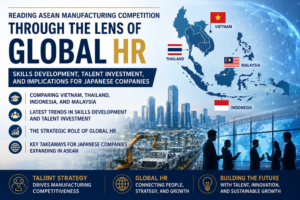
Reading ASEAN Manufacturing Competition through the Lens of Global HR

RELATED ARTICLE
-
HRBP: Stay in HR or Step into Business? 3 Conditions for Impact
-
HRのままで終わるか、経営に入るか|HRBPがビジネスにインパクトを与える3つの条件【2026年最新版】
-
世界の 人事 資格 の現状(2026年版・最新版) 前編 | グローバルで「人事プロフェッショナル」と認識される 人事 資格 とは
-
世界の 人事 資格 の現状(2026年版・最新版)【後編】 世界の 人事 資格 は「知識証明」から「経営参画能力の証明」へ
-
人事 資格 おすすめ10選【2026年版】 人材・労務・HRキャリア・転職に役立つ資格取得ガイド
-
米国 の従業員がメンタルヘルス危機に直面したら― 米国 人事・雇用主が押さえる8つの実務対応
-
When Employees Are in Crisis: How Should HR and Employers Respond? – 8 Practical Steps for HR and Employers in the U.S.
-
人事 資格 の学びを世界の実践へ〜第四回世界人事会議「26GHR-Tokyo」の見どころ


-前編-300x169.jpg)
-後編-300x169.jpg)
-300x169.jpg)