Reading ASEAN Manufacturing Competition through the Lens of Global HR
Skills Education, Talent Investment, and Implications for Japanese Companies
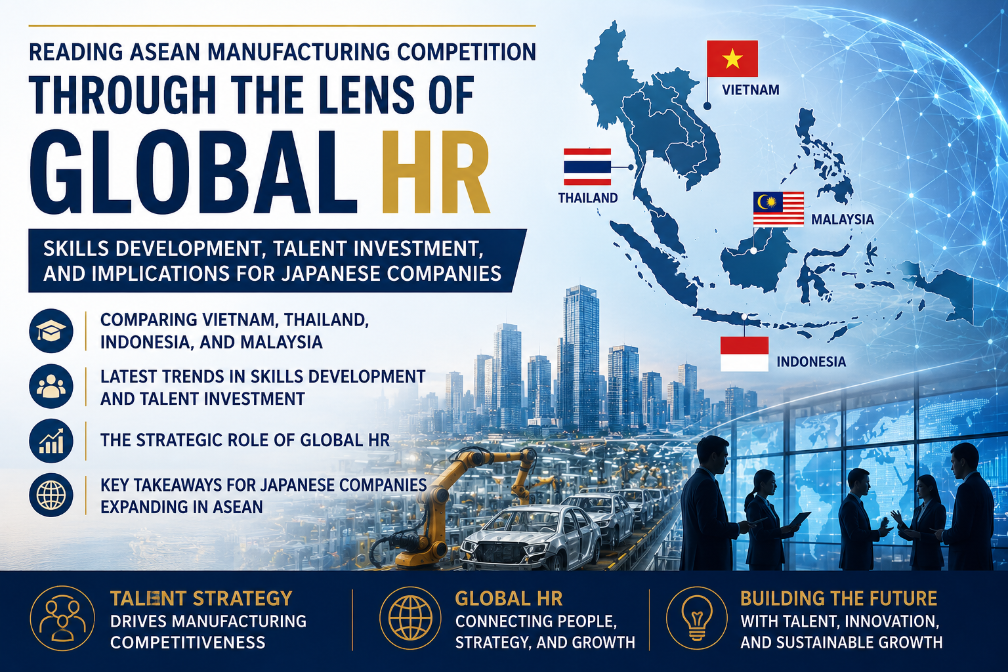
Introduction: From Manufacturing Competition to Talent Competition
ASEAN’s manufacturing landscape is entering a major turning point and so as Global HR strategies. For many years, ASEAN has often been discussed as a region of low-cost production, young labor forces, and foreign direct investment. For Japanese companies in particular, Vietnam, Thailand, Indonesia, and Malaysia have remained important production bases, sales markets, and nodes in regional and global supply chains.
Yet the change now underway is not merely a question of where to locate a factory. ASEAN countries are simultaneously advancing industrial policy and talent policy toward new growth domains: higher-value manufacturing, semiconductors, electric vehicles, AI, green industries, and the digital economy.
In other words, ASEAN competition is no longer simply a competition for inexpensive labor. It is becoming a competition over which countries can develop the talent required to support next-generation industries.
Vietnam, Thailand, Indonesia, and Malaysia each possess distinct strengths. Vietnam has cost competitiveness and export momentum. Thailand has a mature automotive industry and supply chain. Indonesia has a vast domestic market and strong potential in EV battery-related industries. Malaysia has strengths in higher-value sectors such as semiconductors, medical devices, and precision manufacturing.
However, it is not enough to read these differences merely as a country-by-country comparison. From a Global HR perspective, the more important question is what kind of skills education, talent investment, and labor-market structure sits behind each country’s industrial competitiveness.
Manufacturing competitiveness is not determined by factories, equipment, infrastructure, and tax incentives alone. Ultimately, competitiveness is sustained by people: talent that can maintain quality on the shop floor, protect and improve equipment, interpret data, comply with international standards, manage cross-border supply chains, and lead local organizations through change.
Therefore, the role now required of Global HR is no longer limited to country-by-country labor administration or expatriate management. Global HR must read each country’s industrial policy, talent policy, and skills agenda, and connect business strategy with talent strategy.
1. What the 2025/2026 ASEAN Manufacturing Comparison Reveals
Source: Vietnam Industrial Intelligence, LinkedIn company posts
Reference image: Industrial sector comparison of Vietnam, Thailand, Indonesia, and Malaysia, 2025/2026. Source: Vietnam Industrial Intelligence.
A comparison of the four major ASEAN manufacturing economies—Vietnam, Thailand, Indonesia, and Malaysia—shows that manufacturing competitiveness cannot be explained by labor cost alone. When economic scale, population, growth, wage levels, industrial ecosystems, and export structure are considered together, the countries reveal fundamentally different axes of competitiveness.
In terms of economic scale, Indonesia stands out. The reference chart places Indonesia’s nominal GDP at approximately USD 1.5 trillion and its population at approximately 285 million, making it the largest market among the four countries. IMF World Economic Outlook data likewise confirms Indonesia as one of ASEAN’s largest economies, with nominal GDP of roughly USD 1.54 trillion. This means that Indonesia should not be viewed only as a production base. It has the potential to grow as a market-driven economy supported by enormous domestic demand, especially in consumer goods, EV batteries, and nickel-related industries.
Vietnam, by contrast, is smaller than Indonesia in economic size, but it is striking in growth and export competitiveness. The reference chart places Vietnam’s nominal GDP at approximately USD 514 billion, its population at approximately 101 million, and its GDP growth rate at 8.0 percent. The World Bank also describes Vietnam’s 2025 growth as supported by recovering manufacturing exports and improving domestic demand. The chart further indicates that Vietnam’s total trade exceeds USD 930 billion, exports exceed USD 475 billion, and manufactured products account for nearly 89 percent of total exports. This suggests that Vietnam’s strength lies less in the size of its domestic market and more in its connection to global supply chains, export competitiveness, and free trade networks.
Monthly manufacturing labor cost also makes Vietnam’s position clear. The reference chart places Vietnam at approximately USD 350 per month, Indonesia at USD 420, Thailand at USD 550, and Malaysia at USD 850. On this basis, Malaysia’s manufacturing labor cost is roughly 2.4 times Vietnam’s, Thailand’s is roughly 1.6 times Vietnam’s, and Indonesia’s is roughly 1.2 times Vietnam’s. Vietnam therefore combines relatively low cost with export-oriented strengths in electronics, semiconductor-related supply chains, and textiles and apparel.
Yet a labor-cost lens alone misses an essential point. Thailand shows slower growth in the reference chart and higher labor costs than Vietnam, but it possesses a mature manufacturing ecosystem built around the automotive industry. Finished vehicle manufacturers, parts suppliers, logistics capabilities, quality management, and skilled labor have accumulated over many years. This depth cannot be replicated quickly. Thailand’s plan to develop 280,000 high-tech workers over the next five years—including 80,000 in semiconductors, 150,000 in EVs, and 50,000 in AI—shows an attempt to connect this existing industrial base to next-generation technologies.
Malaysia, meanwhile, has the smallest population among the four countries, at approximately 35 million, but it has significant strengths in semiconductors, medical devices, precision manufacturing, and higher-value exports. Its manufacturing labor cost is shown as the highest among the four, at approximately USD 850 per month. However, this higher cost also reflects a labor market with stronger technology capabilities, English proficiency, quality discipline, and international business readiness. Through National Training Week 2025, Malaysia has also positioned skills development as a regional agenda, offering tens of thousands of training opportunities to ASEAN citizens in areas such as AI, digitalization, green technology, and leadership.
The core insight from this comparison is that ASEAN manufacturing competition is no longer a simple contest of low wages. Indonesia offers a vast USD 1.5 trillion-scale market. Vietnam combines high growth and export competitiveness. Thailand offers a mature automotive and supply-chain base. Malaysia offers higher-value manufacturing and technical talent. Each country competes on a different strategic axis.
The Global HR Perspective in ASEAN
From a Global HR perspective, companies must therefore avoid comparing ASEAN countries by a single standard. The more important question is: in which country should a company build which capabilities?
In Vietnam, the central challenge is to develop low-cost talent into higher-value manufacturing talent. In Thailand, the priority is to reskill accumulated industrial talent toward EVs, semiconductors, and AI. In Indonesia, the task is to convert population scale into a skilled workforce through a stronger skills supply system. In Malaysia, the issue is to attract, retain, and further develop highly specialized talent. These are not merely HR issues. They are business strategy issues.
In short, the data does not tell us which country is universally superior. It tells us that companies need country-specific talent strategies grounded in economic scale, growth, labor cost, industrial base, and talent investment. ASEAN manufacturing competition is moving from factory-location competition to talent-competitiveness competition. This is where Global HR has a major role to play in management decision-making.
2. Vietnam: From Low-Cost Manufacturing to a High-Tech Talent Nation
Vietnam has become one of the most closely watched manufacturing economies in ASEAN. Its strengths include relatively low labor cost, a young workforce, a stable investment environment, free trade agreements, and export-oriented industrial policy. Many global companies have positioned Vietnam as an important manufacturing base in the context of China+1 strategy.
Yet Vietnam’s next challenge is clear: whether it can transition from a low-cost manufacturing base to a higher-value manufacturing base.
The semiconductor sector is especially important. Vietnam has set a goal of developing a workforce of approximately 50,000 people for the semiconductor industry by 2030. Vietnam News has reported that the Vietnamese government is advancing a plan to train a 50,000-strong workforce for the semiconductor industry. Vietnam’s national semiconductor strategy also calls for more than 50,000 university-level or higher talent capable of supporting the semiconductor value chain by 2030, including advanced talent in AI.
Source: Vietnam News, “VN to develop a 50,000-strong workforce for semiconductor industry”
Source: Vietnam News, “Strategy issued to develop Viet Nam’s semiconductor industry”
This movement is not merely about attracting factories. A semiconductor industry requires engineers, researchers, equipment technicians, quality assurance professionals, data talent, project managers, and people who can receive technology transfer in English. Vietnam is seeking to move from being a provider of inexpensive labor to becoming a talent nation capable of taking on higher-value roles in the global supply chain.
This transition, however, will not be easy. A country that has grown through cost competitiveness inevitably faces skill gaps when moving into higher-value industries. Production-line workers may be available, but talent capable of process design, quality assurance, R&D, and international project management may be scarce.
For companies entering Vietnam, hiring alone is not enough. They must clarify the skills required for their own businesses, develop local talent step by step, and create pathways for local leaders to assume management responsibilities.
The Global HR question in Vietnam is therefore not simply whether labor can be hired cheaply. The real question is how companies can develop the talent that will support future higher-value manufacturing.
3. Thailand: Connecting a Mature Manufacturing Ecosystem to Next-Generation Technologies
Thailand has one of ASEAN’s most mature manufacturing ecosystems. In the automotive industry in particular, Thailand has accumulated finished vehicle manufacturers, parts suppliers, logistics capabilities, and skilled labor over many years. Thailand’s strength is not simply the number of factories located in the country, but the depth of the industrial ecosystem.
Thailand, however, is also at a major turning point. It is seeking to upgrade its industrial structure from conventional automotive manufacturing toward EVs, semiconductors, AI, digital industries, and green industries.
Reuters has reported that Thailand plans to develop 280,000 workers in high-tech sectors over five years, including 80,000 in semiconductors, 150,000 in EVs, and 50,000 in AI. This is not only a policy for students and researchers. It is also a reskilling and upskilling agenda for existing industrial talent. For a mature manufacturing economy like Thailand, the issue is not building an industrial base from zero. The issue is connecting an existing base to next-generation technologies.
Source: Reuters, “Thailand targets 280,000 workforce in high-tech sectors over 5 years”
For example, as the automotive industry moves toward EVs, knowledge of engines and conventional machining is no longer sufficient. New knowledge is required in batteries, electrical systems, sensors, software, data communications, safety standards, and cybersecurity.
In AI and semiconductors, companies need not only R&D talent but also implementation talent: people who understand technology, translate it into processes, and manage quality on the shop floor. This is both the challenge and the potential of Thailand’s talent strategy.
At the same time, a mature industrial structure can create inertia. The stronger the accumulated success model, the harder it can be to shift toward new technologies. Yesterday’s strengths can become tomorrow’s constraints.
The Global HR role in Thailand is therefore to support reskilling, job redesign, skills-map renewal, and career transition. Companies must review their talent portfolio and determine how existing industrial capabilities can be connected to new technological requirements.
Thailand is a country where the key question is how to transform a mature talent base. For Japanese companies, Thailand can be more than a production base. It can become a hub for regional management, talent development, supply-chain upgrading, and technology transfer.
4. Indonesia: Building the Skills Supply System for a Vast Market
Indonesia has one of the largest populations and domestic markets in ASEAN. Its strengths include a vast consumer market, abundant natural resources, a young population, and strong potential in EV battery-related industries. The EV battery sector, supported by nickel resources, is expected to remain a major pillar of industrial policy.
Indonesia’s greatest challenge, however, is also talent.
According to an Australian Department of Foreign Affairs and Trade sector snapshot, Indonesia will need 57 million skilled workers by 2030. This is not simply a matter of employing many people. It is a question of whether population scale can be transformed into true talent competitiveness.
Source: DFAT, “Education, Skills and Training Sector in Brief”
Indonesia’s technical and vocational education and training system, often referred to as TVET, is also distributed across multiple ministries and levels of government. The OECD has pointed out that responsibility for Indonesia’s vocational education and training policies is spread across the Ministry of Manpower, the Ministry of Education and Culture, other ministries, and provincial and municipal governments.
Source: OECD, “Employment and Skills Strategies in Indonesia”
In a country with Indonesia’s geographic scale and regional diversity, it is difficult to build a uniform national talent development model. This can create gaps between the skills demanded by industry and the skills provided by education and training institutions.
At the same time, as green jobs, digital industries, and EV-related sectors expand, vocational education and training become even more important. The World Economic Forum has introduced Indonesia’s efforts to revitalize technical and vocational education and training in support of the transition to green jobs.
Source: World Economic Forum, “Why Indonesia’s green jobs and vocational training drive matters”
New industries create new jobs. New jobs require new skill definitions. To develop those skills, education providers, corporate training, qualification systems, and labor-market information must be connected.
The Global HR question in Indonesia is therefore not that hiring is easy because there are many people. The more important question is how population scale can be converted into skilled talent.
Japanese companies operating in Indonesia cannot rely solely on a fully formed talent market. They must define the job requirements their businesses need and work with local education institutions, vocational training providers, government bodies, and industry associations to help build the talent supply system itself.
5. Malaysia: Precision Talent and Skills Strategy for High-Value Manufacturing in the AI Era
Malaysia has strengths in higher-value manufacturing within ASEAN. In semiconductors, electronics, medical devices, precision manufacturing, and engineering, Malaysia has long been integrated into global value chains. English proficiency, international business readiness, quality management, and precision manufacturing experience all support Malaysia’s competitiveness.
Malaysia is also investing in talent development for the AI era. The Malaysian Investment Development Authority has highlighted how AI and automation are reshaping Malaysia’s economy and labor market, increasing demand for specialized skills.
Source: MIDA, “Preparing Malaysia workforce for an AI-driven 2025”
National Training Week has also become a major initiative for expanding skills opportunities. The World Economic Forum has described Malaysia’s decision to open National Training Week 2025 to ASEAN citizens, with 65,000 high-quality skills training courses. HRD Corp likewise announced that National Training Week 2025 would offer more than 65,000 free courses nationwide and online to ASEAN citizens.
Source: World Economic Forum, “How Malaysia has been preparing its workforce for the future”
Source: HRD Corp, “Malaysia opens National Training Week to all ASEAN citizens for the first time”
These learning opportunities in AI, digitalization, green technology, and leadership are closely connected to the upgrading of manufacturing. Future manufacturing will require people who do more than operate machinery. It will require talent that can interpret data, detect abnormalities, propose improvements, and maintain quality according to international standards.
Malaysia’s strength is therefore not low cost. It is the ability to utilize talent that creates high value.
At the same time, countries that rely on advanced talent also face intense talent competition. Talent in semiconductors, AI, data, medical devices, and precision manufacturing is sought not only by domestic firms but also by global companies. Recruitment alone is not enough. Retention, career development, professional career tracks, reward systems, and leadership development are critical.
The Global HR role in Malaysia is to build organizations that can attract, develop, and retain highly specialized talent. Compensation matters, but growth opportunities, recognition of professional expertise, career pathways, and participation in global projects are also key to retention.
6. The Essence of Global HR Strategy Seen through ASEAN Manufacturing
Vietnam, Thailand, Indonesia, and Malaysia are all major ASEAN industrial economies, but their strengths differ clearly. Vietnam offers cost competitiveness and export strength. Thailand offers a mature automotive industry and supply chain. Indonesia offers a vast domestic market and EV battery-related potential. Malaysia offers high-value sectors such as semiconductors and medical devices.
The essential question is not simply which country is winning. The real question is what kind of talent competitiveness lies behind each country’s industrial competitiveness.
Manufacturing competitiveness is no longer determined by labor cost alone. Building factories, attracting foreign investment, and developing export infrastructure remain important. However, they do not by themselves create sustainable growth. Advanced manufacturing requires operational talent, quality management talent, data-capable talent, supply-chain talent, and leaders who can adapt to change.
ASEAN competition is therefore both a competition for industrial investment and a competition for talent development.
Thailand’s automotive ecosystem, for example, reflects accumulated industrial talent, skills, management experience, and supply-chain operations. Indonesia’s EV battery ambitions require not only resources and equipment but also engineers, quality management professionals, safety specialists, and managers who can collaborate with global companies. Malaysia’s high-value industries require precision, technology literacy, compliance, English communication, and responsiveness to international standards. Vietnam’s next task is to move from low labor cost to higher productivity and high-tech talent.
This is where Global HR becomes central. Global HR is not merely the management of HR operations in overseas entities. It is the function that understands labor markets, culture, legal systems, education levels, wage structures, and industrial policies across countries, and connects them to business strategy.
7. What Japanese Companies Must Rethink in ASEAN Talent Strategy
The manufacturing competitiveness of Vietnam, Thailand, Indonesia, and Malaysia is tied to different talent challenges.
- Vietnam is attempting to move from low-cost manufacturing to a high-tech talent nation.
- Thailand is attempting to transform a mature manufacturing ecosystem toward next-generation technologies.
- Indonesia is attempting to convert a vast population and market into a skilled workforce.
- Malaysia is strengthening specialized talent and skills strategy for high-value industries and the AI era.
This means it is no longer appropriate to view ASEAN as a single region of inexpensive labor. Each country has its own industrial policy, talent policy, and skills agenda.
For Japanese companies to remain competitive in ASEAN, country-specific talent strategy is essential. Which jobs should be assigned to which country? Which skills should be developed where? Where should local leaders be cultivated? Which country should serve as a manufacturing base, a technology base, or a regional management hub? Which country’s talent could eventually be deployed to other markets?
These are all central questions for Global HR.
8. Global HR Is Evolving from Overseas HR Administration to a Management Advisory Function
Traditionally, overseas HR has often meant expatriate management, local hiring, compensation, benefits, labor administration, and assignment and repatriation processes. These remain important, but they are no longer enough.
Global HR must understand each country’s industrial policy, skills policy, labor market, wage structure, education system, culture, and legal environment, and connect business strategy with talent strategy.
In Vietnam, this means linking hiring and development strategy to semiconductors and high-tech talent development. In Thailand, it means reskilling mature industrial talent for the EV and AI era. In Indonesia, it means building talent supply models with education and training institutions rather than relying only on the labor market. In Malaysia, it means creating reward systems and career structures that attract and retain advanced technical talent.
Global HR is therefore not simply about employing people overseas. It is a management function that designs where and how talent capabilities should be built globally, and how those capabilities should be connected to business growth.
This is why HR must develop the capacity to advise management. Can the necessary talent truly be hired in that country? If not, can it be developed? How many years will development require? Can local managers be cultivated? Can professional career paths be established? How should the balance between headquarters control and local autonomy be designed? Will education investment lead to future productivity gains?
These are HR questions, but they are also management questions.
9. Implications for Japanese Companies: Overseas Expansion Succeeds or Fails through Talent Design
For Japanese companies, the key is not to treat ASEAN as a uniform region.
- Vietnam requires a Vietnam-specific talent strategy.
- Thailand requires a Thailand-specific talent strategy.
- Indonesia requires an Indonesia-specific talent strategy.
- Malaysia requires a Malaysia-specific talent strategy.
At the same time, these country-specific strategies must not remain isolated. They must be integrated into an overall Global HR strategy.
Vietnam may be positioned as a country where young talent is developed while manufacturing moves up the value chain. Thailand may be positioned as a country where mature industrial talent is reskilled for next-generation technologies. Indonesia may be positioned as a country where companies co-create talent supply systems with local institutions. Malaysia may be positioned as a country where highly specialized talent is utilized and retained.
Overseas expansion is not determined only by country selection. It is determined by what kind of talent is hired, developed, entrusted, and retained after entry. This is the essence of Global HR.
10. HRAI’s View of Global HR: Connecting Japan and the World through HR
For HRAI, Global HR is not simply the HR function of overseas operations. It is the capability to read global change, advise management from the perspective of talent, and design the organizational capabilities required for business growth across borders.
The ASEAN manufacturing comparison illustrates this point clearly. A country’s competitiveness is not determined only by GDP, population, wages, or infrastructure. It is determined by what skills are being developed, what talent policies are in place, what educational investments are being made, and what industrial talent is accumulating.
The same is true for companies. Which country should they enter? Which industries should they invest in? Which talent should they hire, develop, and entrust? How should they develop local leaders? How should headquarters and local operations be connected? How should the entire system be integrated as Global HR strategy?
HR professionals who can answer these questions will become indispensable to management.
The age of industrial competitiveness is shifting toward an age of talent competitiveness. ASEAN countries are raising their industrial competitiveness through talent investment. Vietnam is investing in high-tech talent. Thailand is investing in EV, semiconductor, and AI talent. Indonesia is investing in skilled labor and green jobs. Malaysia is investing in high-value talent for the AI era.
This is not only an ASEAN story. Across the world, industrial policy and talent policy are becoming inseparable. Manufacturing, AI, semiconductors, EVs, green industries, medical devices, and digital infrastructure all ultimately depend on talent.
For this reason, Japanese companies need Global HR talent capable of reading global talent competition and advising management accordingly. HRAI will continue to interpret global change through the lens of talent and to share the learning and practice of Global HR under its mission of “Connecting Japan and the World through HR.”
11. GHR-ACADEMY™: HRAI’s Systematic Global HR Education and Certification
HRAI’s Global HR education and certification are beginning to expand into ASEAN as well. For ASEAN countries, it is increasingly important to develop HR professionals who can systematically learn Global HR and design talent strategy from an international perspective. As manufacturing advances, skills education, reskilling, and talent investment progress, the need for professionals who can understand Global HR and connect management with talent is growing.
Source: GHR-ACADEMY™ / HRAI
Source: Voices from ASEAN participants
12. HRAI’s Global HR Network across ASEAN and Asia
HRAI does not merely analyze the talent strategies of ASEAN countries from the outside. Through the Global HR Conference in Japan, university engagements, government and administrative institutions, and corporate HR leaders, HRAI has built continuing relationships of trust and a track record in Global HR across ASEAN and Asia.
In Malaysia, HRAI has delivered lectures at a university and engaged with students and educators on next-generation talent development, Global HR, and international career formation. This reflects HRAI’s commitment not only to corporate HR but also to educational institutions that are shaping the future of talent development in Asia.
Source: HRAI, Malaysia university lecture
In Thailand, under a Thai government-led initiative, HRAI welcomed a Global HR education and training delegation from the Bangkok Metropolitan Administration. Providing administrative HR officers with the opportunity to learn in Japan about Global HR, talent development, organizational management, and leadership demonstrates HRAI’s trusted role as a cross-border platform for HR education.
Source: Thai government delegation completion document
From the Cambodian government, a delegation including eight HR officers from the financial regulator joined the Third Global HR Conference in Japan last year, contributing to international dialogue on institutions, industries, and talent development.
Source: HRAI, Cambodia delegation column
In addition, every year the Global HR Conference in Japan welcomes HR leaders and government delegations from ASEAN, Asia-Pacific, Europe, North America, and Africa. They share the practical knowledge of each country’s HR challenges, talent development, leadership, and organizational development.
These achievements show that HRAI is not merely a domestic HR education institution in Japan. It has grown into a Global HR platform that connects HR leaders, administrative institutions, and educational institutions around the world.
To understand ASEAN’s talent competitiveness, statistics and policy documents are not enough. It is essential to hear the real voices of local HR leaders, understand the talent development issues faced by public institutions, and learn how educational institutions are preparing the next generation. This is where HRAI’s strength lies: not only learning about global HR, but connecting with global HR leaders, public institutions, and educational institutions, and transforming those dialogues into perspectives that allow Japanese HR professionals to advise management.
13. Toward the Fourth Global HR Conference in Japan
The structural changes, talent investments, and skills education underway in ASEAN are not distant issues for Japanese companies. ASEAN countries including Vietnam, Thailand, Indonesia, and Malaysia are no longer simply manufacturing bases. They are evolving into important partners in talent, technology, and management for next-generation industries.
For this reason, Global HR must go beyond understanding local labor markets and systems. It must engage with local executives, HR leaders, educational institutions, and policymakers to design cross-border talent strategies.
At the Fourth Global HR Conference in Japan, hosted by HRAI, HR leaders, executives, and experts leading Global HR from ASEAN and around the world will gather to discuss global talent issues, changes in industrial structure, skills education, talent investment, leadership, and the global expansion of Japanese companies.
Source: Fourth Global HR Conference in Japan
In past conferences, official delegations from ASEAN countries including Brunei, Cambodia, Malaysia, the Philippines, and Singapore have participated. From Thailand, HRAI also welcomed a training delegation from the Bangkok Metropolitan Administration. Beyond ASEAN, every year the conference welcomes HR leader delegations from other countries, creating a setting for the exchange of practical knowledge on HR challenges and talent development.
Government participation has also been an important feature. Last year, a delegation of HR officers from Cambodia’s financial regulator attended, and the previous year, senior HR officials from the Korean National Police Agency visited Japan. Through these exchanges, the conference has fostered international dialogue across government, business, and academia on national policy, talent development systems, industry, and human capital development.
Source: International Delegations, Fourth Global HR Conference in Japan
Conclusion: The Role of Global HR in ASEAN Talent Strategy
As this column has argued, ASEAN manufacturing competitiveness can no longer be explained by labor cost alone. Vietnam’s development of high-tech talent, Thailand’s reskilling for EVs, semiconductors, and AI, Indonesia’s skilled workforce development, and Malaysia’s high-value talent strategy are all critical themes on which Global HR must advise management.
The Fourth Global HR Conference in Japan will provide an opportunity to reinterpret global talent competition not as a distant overseas trend, but as a management challenge for Japanese companies. How should we read ASEAN’s growth? How should country-level talent policies be connected to business strategy? How should local talent be developed and local leaders appointed? And how can Japanese HR contribute to global management?
These are the questions that define the next era of Global HR.
Under its mission of “Connecting Japan and the World through HR,” HRAI will continue to deepen dialogue with HR leaders and executives from ASEAN and around the world, and to create a platform for developing Global HR talent capable of reading global talent competition and advising management.
References

華園ふみ江
一般社団法人 人事資格認定機構
代表理事
米国公認会計士
ASTAR LLP 代表

RELATED ARTICLE
-
 第四回世界人事会議 26GHR-Tokyo のプレスリリースを発表し、Googleなど24の主要メディアにとりあげられました。
 -
HRBP: Stay in HR or Step into Business? 3 Conditions for Impact
-
HRのままで終わるか、経営に入るか|HRBPがビジネスにインパクトを与える3つの条件【2026年最新版】
-
世界の 人事 資格 の現状(2026年版・最新版) 前編 | グローバルで「人事プロフェッショナル」と認識される 人事 資格 とは
-
世界の 人事 資格 の現状(2026年版・最新版)【後編】 世界の 人事 資格 は「知識証明」から「経営参画能力の証明」へ
-
人事 資格 おすすめ10選【2026年版】 人材・労務・HRキャリア・転職に役立つ資格取得ガイド
-
米国 の従業員がメンタルヘルス危機に直面したら― 米国 人事・雇用主が押さえる8つの実務対応
-
When Employees Are in Crisis: How Should HR and Employers Respond? – 8 Practical Steps for HR and Employers in the U.S.



-前編-300x169.jpg)
-後編-300x169.jpg)
-300x169.jpg)