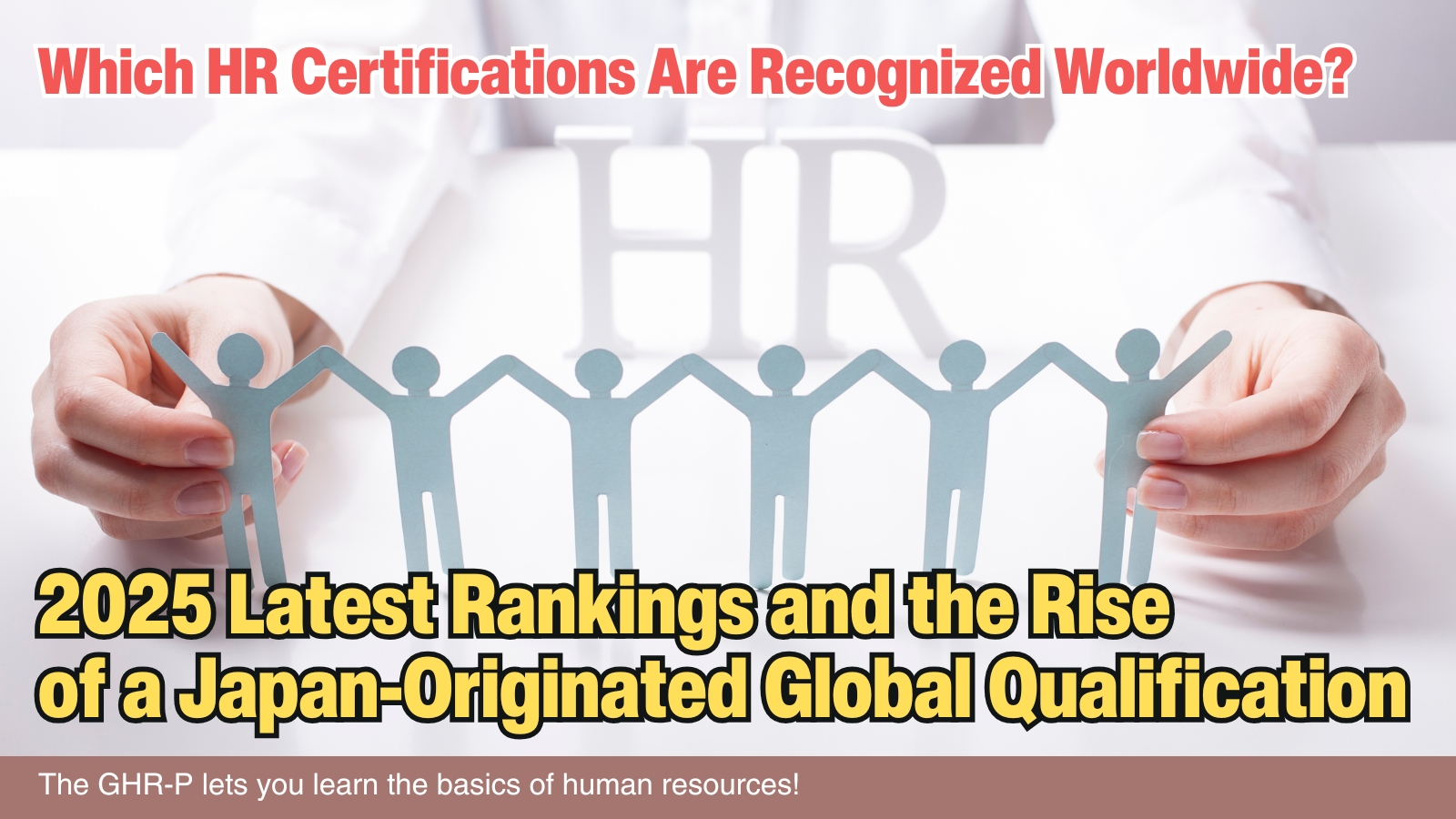
What HR Certifications Are Recognized Globally? 2025 Ranking and the Rise of a Japan-Origin Global HR Certification
What HR Certifications Are Recognized Globally? 2025 Ranking and the Rise of a Japan-Origin Global HR Certification
This article explores the theme, “What HR Certifications Are Recognized Globally? 2025 Ranking and the Rise of a Japan-Origin Global HR Certification,” and explains the characteristics and historical background of major HR certifications around the world.
Today, HR certifications are no longer merely proof of knowledge. In Japan as well, they are beginning to serve as a global passport that enables professionals to contribute across borders and organizations.
In addition, this article examines the birth and significance of GHR-Professional, a new Japan-origin global HR certification built on global HR standards while integrating human capital management and the latest HR trends beyond the traditional U.S.-centered certification framework.
In the years ahead, HR certification will not simply prove where you can work, but rather how you can create value anywhere in the world. This article provides a structured overview of that evolution.
Comparing HR Certifications: Global Ranking, Certification Period, Number of Certified Holders, Launch Year, and Key Features
HR certifications now range from institution-based certifications originating in Europe and the United States, such as SHRM and CIPD, to practice-oriented certifications developed in Japan. In recent years, as human capital management and global capability have become more important, HR certifications have taken on a broader role as a global career passport rather than just proof of knowledge.
| Ranking | Qualification Name | Accreditation Body | Number of Acquirers (including estimates) | Qualification start year | Features |
| 1 | PHR (Professional in Human Resources) | HRCI | Approx. 65,341 | In 1976 | Practical certifications spread mainly in the United States |
| 2 | SPHR (Senior Professional in Human Resources) | HRCI | Approx. 41,692 | In 1976 | Advanced Qualification in Strategic Human Resources Management |
| 3 | SHRM-CP (SHRM Certified Professional) | SHRM | Private (estimated tens of thousands) | In 2015 | Competency-based human resources and practical certifications |
| 4 | SHRM-SCP (SHRM Senior Certified Professional) | SHRM | Private (estimated tens of thousands) | In 2015 | Strategic Human Resources Leadership Qualification |
| 5 | CIPD (Chartered Institute of HR and Development) | CIPD (UK). | Approximately 150,000 or more | 1980s (Development of the qualification system) | Human resources certifications popular in Europe, the Middle East, and Asia |
| 6 | aPHR (Associate Professional in HR) | HRCI | Approx. 10,323 | In 2016 | For Beginner HR Professionals |
| 7 | PHRi (Professional in Human Resources – International) | HRCI | Approximately 3,492 | In 2012 | Certifications for International Human Resources Practitioners |
| 8 | SPHRi (Senior Professional in Human Resources – International) | HRCI | Approx. 3,221 | In 2012 | For strategic international HR leaders |
| 9 | GPHR (Global Professional in Human Resources) | HRCI | Approx. 2,798 | In 2004 | Global HR Strategy Qualification |
| Special note | SHRM Essentials of Human Resources | SHRM and HRAI in Japan | 330 in Japan alone (2020-2024) | 2021 (Japan) | Introductory HR Education Program |
HRCI certifications were originally provided by SHRM, but the partnership ended at the end of 2014. Since 2015, SHRM has launched its own certifications (SHRM-CP, SHRM-SCP). Therefore, HRCI and SHRM now operate separate qualification systems.
| New Qualification Name | Accreditation Body | Offer start year | Features |
| GHR-Professional (International Qualification in Human Resources) | HRAI (Japan) | 2025 | Based on SHRM Essentials, the company is expanding globally as the latest and strategic human resource certifications such as human capital management and people analytics from Japan |
Human Resources Certifications and Historical Background. How has human resources developed into a globally recognized profession validated by specific certifications?
HR Certification was mainly systematized after the 1970s and has spread worldwide. Typical certifications and the year they start offering are as follows.
- 1970s: HR certifications are standardized, especially in the United States; HRCI begins offering PHR and SPHR, and HR specialization advances.
- 1980s-90s:
Certifications became commonplace, and specialized HR positions became popular.
With the advancement of globalization, the demand for international certifications is expanding.
- Since the 2000s:
Global business development has become commonplace, and international certifications such as GPHR have begun to be offered.
CIPD has also reorganized its qualification system and spread rapidly in Europe, the Middle East, and Asia.
- 2010s:
In line with the trend toward emphasizing competencies, SHRM launched its own certifications (SHRM-CP, SHRM-SCP). The company has also started offering
International HR certifications (PHRi, SPHRi) to capture demand outside the United States.
- 2020s and beyond:
Certifications for new fields such as human capital management and people analytics are also emerging.
In other words, human resources used to be seen merely as a “support function” managing the system. However, with globalization, they have transitioned from being viewed as a “cost” to recognized as “capital that adds value,’ thereby becoming central to management. Reflecting this shift, in Europe and the United States, human resources is now explicitly classified as a “professional’ field, supported by certifications like SHRM and CIPD.
Today, we operate in an increasingly advanced era. It’s no longer solely about human capital management, people analytics, AI, and knowledge; it also involves questioning “how much influence can be exerted on management.” As a result, HR credentials are transforming into “global passports” that showcase universal expertise in human resources, rather than just proof of knowledge. Human resources are no longer confined behind the scenes. The time has arrived to demonstrate one’s value as a pivotal driver in management. Holding “vocational professional certifications” has become a global standard for professionals, already recognized internationally, with Japan now following suit.
The Evolution of HR Certification in Japan: The Dawn of Global HR Professionalization
2020 Establishment of HRAI and partnership with SHRM
In 2020, the Society for Human Resource Management (SHRM), one of the world’s largest HR professional organizations, was founded to support the development and expertise of human resources professionals in Japan. HRAI (Human Resource Accreditation Institute), as SHRM’s exclusive partner in Japan, launched the “SHRM Essentials of Human Resources Japanese.” This marked SHRM’s first effort to translate its educational materials into languages other than English. Following the successful Japanese translation, SHRM has expanded to include multilingual offerings in Korean and Arabic.
SHRM Essentials is an introductory program designed to provide basic knowledge (introductory level) of human resources systematized from a global perspective, mainly in the United States, and has been available in Japan since 2021 in the following aspects.
- You can learn the basic concepts of world-class human resources (introductory level)
- Understand the role of global HR
- Understand the operational fundamentals of human resources in the United States
- It is ideal for the early days of globalization and specialization of human resources functions of Japanese companies.
- In the United States, it is an introductory course to human resources offered at universities, and in 2020, it was required to be introduced in Japan, where systematic human resources education was not widespread
Selected as SHRM Top International Partner in 2023
Over the four years from 2021 to 2024, 330 people completed the SHRM Essentials program through HRAI. In 2023, HRAI was recognized as a “Top International Partner” by SHRM for the highest number of courses taken outside the United States. Additionally, the fact that participants included not only Japanese residents but also individuals from around the world has solidified HRAI’s reputation as a pioneer in global human resources education in Japan, especially in 2023. The globalization of human resources in Japan has accelerated over the years, and the SHRM Essentials program, which provides introductory education in global human resources, has played its part.
Human Resources Certifications: A New Global Evolution from Japan, from SHRM Essentials to Global HR Certifications (GHR-P)
Over the course of four years of delivery, HRAI has recognized the following challenges and needs:
- The content of the conventional SHRM Essentials (introductory level of human resources knowledge and explanation of U.S.-centered human resource practices) was not enough for Japanese companies.
- Including the characteristics of Japanese companies, we have a global perspective that is not biased only towards the United States, human capital management, people analytics, DE&I, etc., and the world’s latest HR such as AI and HRDX. There was a need to incorporate trends more deeply and systematically.
- We recognized the importance of disseminating HR certifications from Japan to the world, and creating our own global standards that take advantage of the advantages of Japanese-style management without relying on certifications from Europe and the United States.
Based on these factors, we have decided to discontinue the SHRM Essentials program at the end of 2024.
2025: The Launch of the GHR-ProfessionalTM
In 2025, HRAI launched the “Global HR Professional Certification: GHR-Professional™︎.” This certification is based on lectures that combine insights from SHRM Essentials with the latest HR trends worldwide, covering a wide range of topics from core global HR principles to practical application. The features and significance of this new qualification are as follows:
- Global HR certifications that are globally applicable, starting in Japan
- Focusing on “human capital management”, the content integrates management and human resources strategy
- Covering the world’s latest people analytics, DE&I, AI, HRDX, and organizational development
- Go beyond the introductory scope of SHRM Essentials and specialize in more strategic and advanced content
- Available in Japanese, English, and bilingual, strengthening communication capabilities from Japan to the world
- Content that fulfills requests from Japan and abroad to “I want to know about the uniqueness of Japanese human resources.”
The importance of the International Qualification in Human Resources (GHR-Professional) lies in bridging the gap between global-standard human resources and Japanese human resources, connecting it to worldwide human resources certifications.
Realization of Japanese-style management and global human resources integration By
adding Japan’s unique management and HR philosophy to conventional Western-centered certifications, it will show a new indicator of global human resources.
Enhance the contribution of human resources to management Human
capital management and contribution to management are the core of human capital management, and human resources are encouraged to become strategic partners directly related to management.
Developing truly global human resources
Strengthen cross-cultural responsiveness, communication skills, communication skills, and leadership to support the “balance between globalization and localization” that has been an issue for Japanese companies.
Development of global HR certifications from Japan to enhance international competitiveness.
Systematizes more universal global HR knowledge and practices based on diverse practices and backgrounds worldwide, without bias toward the U.S. or specific regions. While starting from a Japanese perspective, we aim to provide practical and valuable learning for multinational companies and human resources managers in each country, and to promote international trust and utilization.
Is your goal to earn a human resources qualification, or do you want to develop world-standard theories and practices of your own?
How to choose a HR qualification | What is the best certification for each career stage?
The most important thing when choosing a human resources qualification is not “which qualification is famous”, but whether it suits your career stage and purpose.
HR certifications can be broadly divided into the following three purposes.
The first is a human resources qualification for introductory purposes and basic understanding.
At this stage, it is important to understand the overall picture and basic concepts of human resources. For those who have not studied human resources systematically, understanding the basics correctly will greatly accelerate future growth. This phase is suitable for those who have just been transferred to human resources or are aiming to enter human resources with no experience.
The second is HR certification to enhance expertise.
At this stage, it is required to establish human resources as a profession. It is necessary to systematically learn about the legal system, the design of evaluation and compensation systems, and the theory of human resource management. Certifications such as SHRM and CIPD are valid during this phase. However, it is important to note that understanding it as knowledge is not enough.
The third is HR certifications to influence management.
What is required of modern human resources is not just system operation but involvement in decision-making that impacts management. Therefore, at this stage, it is essential to understand human capital management, utilize people analytics, align with management strategies, and participate in global management. Here, for the first time, HR certifications act as a global passport.
Are HR certifications meaningless?
Some people say that HR certifications are meaningless, but the conclusion is that the certifications themselves are meaningful, not what they have acquired.
Therefore, the idea that obtaining a qualification will advance your career, be evaluated, and be accepted globally is a misconception. Certifications are only proof of ability, that is, passports that can pass through gates, and their value is limited if they cannot be used in practice.
What is important is what kind of knowledge, skills, and abilities you acquire through certifications and how you can apply them in practice. Only when it reaches a level that affects management does HR certifications have meaning.
In other words, the essence of HR certifications lies not in “acquisition” but in “change”.
Why are HR certifications attracting attention in Japan now?
In recent years, there has been a clear structural shift in the focus of HR certifications in Japan. First, the flow of human capital disclosure has increased. Companies are now held accountable for their investment in talent and for their transparency and responsibility. As a result, human resources is no longer just a management function but a role that creates management value. Second, global competition is intensifying. Companies need to compete not only in the domestic market but also globally, and international standards are now essential for human resources. Third, there is a shift toward professionalizing human resources. In Japan, HR was traditionally viewed as a job handled through transfers, but now the role of a professional with specialized knowledge and skills is required. Therefore, amid these changes, HR certifications are becoming increasingly important not just as proof of knowledge but as a way to demonstrate expertise and practical skills.
Conditions Necessary for Future HR Certifications
In the future, the criteria for selecting HR certifications will be clearly defined. First, the certification should originate from a globally recognized HR system with a broad international perspective. It’s crucial to adopt a viewpoint applicable across different countries, rather than being biased toward the systems or practices of a specific nation. Second, the certification must be directly relevant to practical work; its value hinges on whether the skills can be applied in real-world situations. Third, the certification should be linked to management roles, as HR’s influence within an organization is limited when it is detached from management functions. In summary, when these criteria are met, HR certifications become more significant and open new career opportunities.
What is your goal? Simply obtaining HR certification? Or acquire world-standard HR knowledge, skills, and abilities?
SHRM is a certification that doesn’t require attending lectures and demonstrates your knowledge through exams.
In other words, it can be said that it is a “knowledge proof” qualification that can be obtained if you pass the exam.
On the other hand, CIPD is an “educational qualification” that deepens understanding through reports and assignments, and emphasizes theory and systematic learning.
Now, here’s a question for you. What do you aim for?
Do you acquire the knowledge, skills, and abilities of human resources that are world-class and obtain certifications as proof? Do you understand HR jargon in both Japanese and English, and raise it to a level where you can use it in practice?
In the International Education Program in Human Resources GHR-P, students learn the essential functions of human resources through “definition” and “practice”.
And it does not end with mere knowledge, but establishes learning as a ability that can be designed and implemented by oneself.
In addition, by acquiring technical terms essential for global human resources in both Japanese and English, students will be raised to a “usable level” in practice.
Getting HR certifications begins by asking yourself key questions.
Are you aiming to earn a “human resources qualification”?
Or do you want to develop a world-class human resources foundation within yourself and showcase your strength?
In the area where you want to make an impact, do you rely solely on English HR jargon, or do you have enough Japanese proficiency to use it effectively?
Basically, which HR certifications—your “passports”—will lead you to your desired destination?
Once you identify this, your next move as a human resources professional will become clear.
First, begin by acquiring human resources certifications.

◾️◾️◾️ Please take a look at this column as well! ◾️◾️◾️
-前編.jpg)
-後編.jpg)

華園ふみ江
一般社団法人 人事資格認定機構
代表理事
米国公認会計士
ASTAR LLP 代表
-
 世界で選ばれる 人事資格 とは? 2025年最新ランキングと日本発グローバル資格の台頭 ー 人事資格 の種類・ランキング・選び方を体系的に解説。SHRM・CIPDなど欧米から派生した 人事資格 に加え、日本と世界基準の人事の違いを理解し、実務に生かすための人事国際資格(GHR-P)まで、人的資本経営時代に求められる人事の専門性を徹人事資格の種類・ランキング・選び方を体系的に解説。
-
The Future of HR in the Age of AI: HRAI’s Vision for Strategic, Tech-Driven HR

RELATED ARTICLE
-
人事 資格 の学びを世界の実践へ〜第四回世界人事会議「26GHR-Tokyo」の見どころ
-
From HR Certification to Global Practice ~ 26GHR-Tokyo Highlights of the Fourth Global HR Conference in Tokyo
-
北朝鮮の詐欺師がITフリーランスを装っている ― グローバル人事 担当者 が知っておくべき本人確認、契約社員リスク、グローバル人材ガバナンス
-
North Korean Scammers are Posing as IT Freelancers: What HR Leaders Should Know About Identity Verification, Contractor Risk, and Global Workforce Governance
-
An Employer’s 5-Step Guide to AI Interviewing and Hiring Tools: Lessons from U.S. Trends for Japanese Companies and Global HR Professionals
-
AI面接・採用ツールのための雇用主向け5ステップガイド:米国のトレンドから学ぶ、日本企業 および グローバルHR 担当者への示唆
-
グローバル人事 の視点で読むASEAN製造業競争 ― スキル教育・人財投資・日本企業への示唆
-
Reading ASEAN Manufacturing Competition through the Lens of Global HR