Total Rewards is the concept of “total compensation” that includes not only salary and bonuses, but also benefits, work styles, career development, approval, and the meaning of working for an organization. In today’s world, where human capital management is emphasized, compensation is not just a cost, but a key management lever for changing organizational behavior and increasing corporate value.
In Japan, in particular, international comparisons of wage levels and the impact of the depreciation of the yen have made compensation competitiveness an issue in the global competition for human resources. On the other hand, Japan has great value, including statutory and non-statutory benefits. The problem is that its value is not fully visible as total compensation.
This paper explains the basic concept of total rewards, the challenges faced by Japanese companies, the significance of translating benefits into monetary value, the case of Hitachi, Ltd., and the importance of global compensation expertise and human resources qualifications, as represented by WorldatWork.
What is Total Rewards?
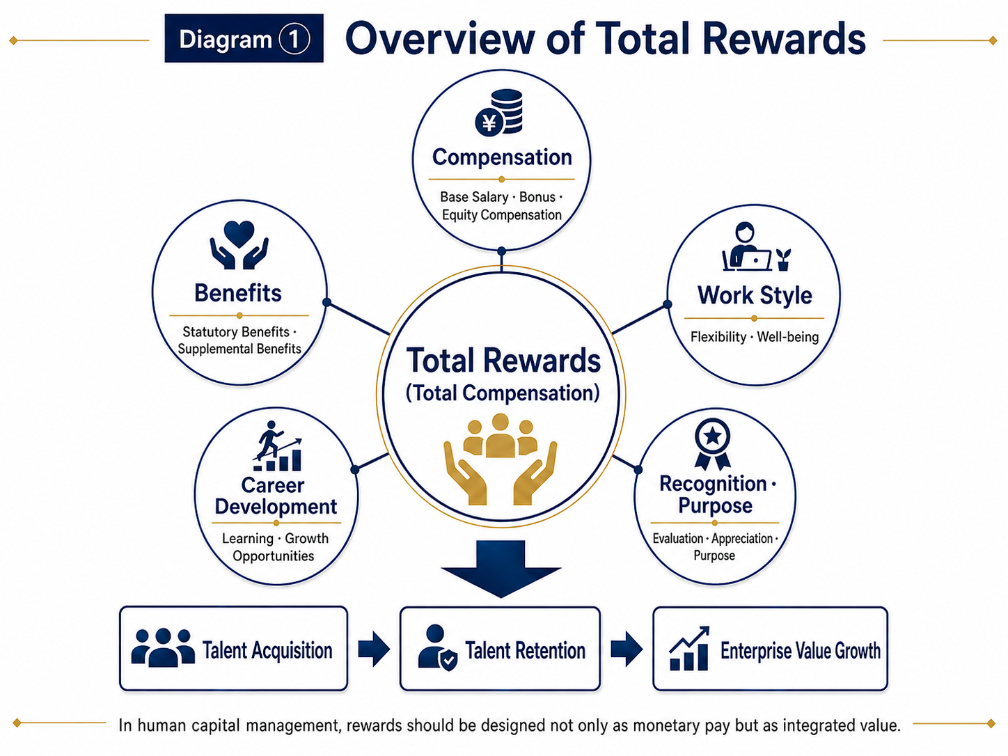
Total Rewards is a concept that takes a broader and more strategic view of traditional compensation systems. The general compensation system mainly consists of salaries, bonuses, allowances, and evaluation systems. But Total Rewards also includes non-monetary values such as benefits, flexible working, career opportunities, learning support, recognition, and a sense of belonging to the organization.
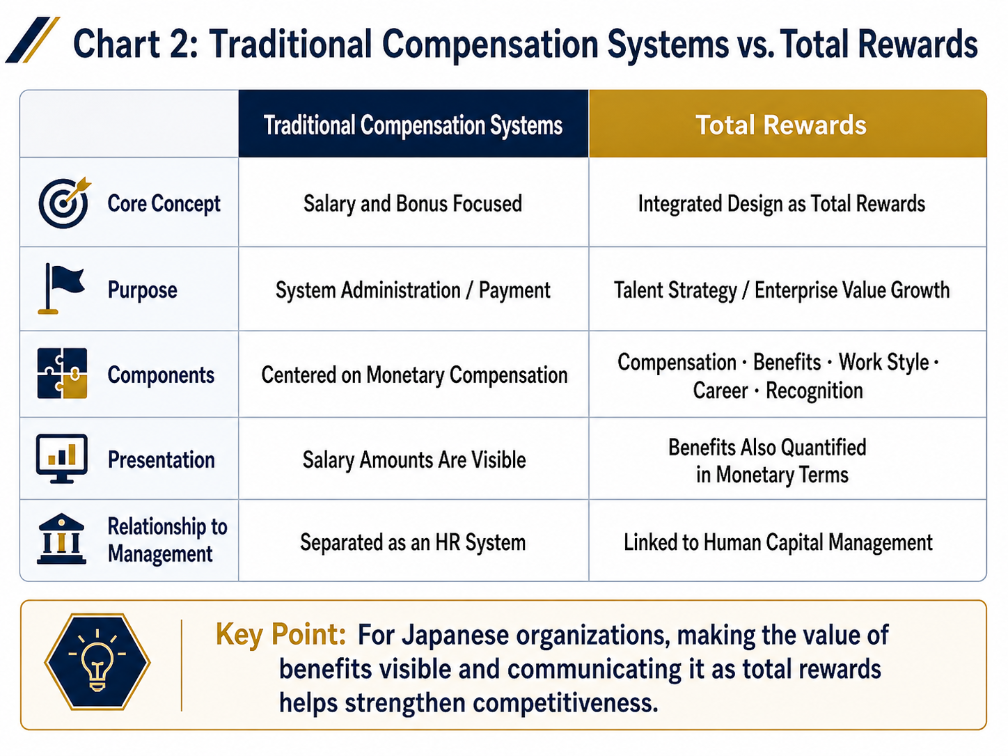
Differences from traditional compensation systems
Conventional compensation systems often limited to “system management” such as the operation of salary tables and evaluation systems. In other words, compensation has been thought to be paid according to performance or managed as a labor cost.
Total Rewards, on the other hand, connects compensation to management strategy. What kind of human resources will you attract, what kind of actions will you inspire, and what kind of corporate value will you create? The design is a major difference from the conventional compensation system.
Why is total rewards important now?
What is now required of organizations is not just to raise salary levels. It is to combine monetary and non-monetary compensation within limited management resources to maximize value for workers.
The key here is to view rewards as an “investment” rather than a “payment.” Rewards are the very message of the organization. What do you value, what do you value, and what kind of actions do you expect? This intention is reflected in the compensation design.
Why Japanese companies’ compensation competitiveness is declining
Japanese companies are facing the challenge of declining compensation competitiveness in the global market. Especially in an era where excellent human resources work across borders, compensation design based only on domestic standards will make it difficult to be selected in the global human resources market.
Impact of the depreciation of the yen
As the yen depreciates, even if the compensation seems reasonable in Japan, the value of the yen will decrease relative in foreign currency terms. As a result, Japan’s compensation level from the perspective of global human resources may seem lower than it actually feels.
Of course, compensation competitiveness is not determined by salary alone. However, the weaker the visibility of basic compensation, the greater the need to comprehensively communicate the value of benefits, career opportunities, and work styles.
Intensifying competition for global talent acquisition
In addition, talented people are choosing careers across countries and regions. Therefore, organizations need to clearly indicate not only the salary level, but also “what value you will get from working here”.
In this competitive environment, the idea of total rewards, which integrates compensation, benefits, learning opportunities, career paths, and flexible working styles, is essential.
The strength of Japanese companies lies in welfare
On the other hand, Japanese companies have major strengths that have been overlooked. That is the enhancement of benefits. Japan has a social insurance system and job protection, and many more organizations also offer non-statutory benefits such as housing allowances, corporate pensions, health support, and vacation programs.
Why benefits are difficult to evaluate
However, these values are not fully appreciated. The reason is clear. This is because salaries are easy to compare as numbers, while benefits are difficult to convert into monetary value and are difficult to convey to candidates and employees.
For example, social insurance, retirement benefits, health support, leave systems, childcare and nursing care support are of great value to workers. Nevertheless, if it is not presented as total compensation, it will appear to be just a list of systems.
The Need for Monetary Value
Therefore, what Japanese companies should work on is to visualize benefits as a monetary value. By converting benefits into monetary value and presenting them as total compensation along with salary, you can more accurately convey the value that Japanese companies inherently have.
This is not just recruitment publicity; In human capital management, it also leads to important information disclosure that shows what kind of investment the company is investing in people.
Specific components of total rewards
In the global standard concept, total rewards are designed by integrating multiple elements. Typical components are compensation, benefits, work styles, career development, and recognition and significance.
Compensation: The value paid monetarily, such as base salary, bonuses, incentives, and stock compensation.
Benefits: Includes social insurance, retirement benefits, health support, leave system, housing support, childcare and nursing care support, etc.
Work style: This system is related to remote work, flextime, flexibility in working location, and work-life balance.
Career Development: Includes training, learning support, reskilling, international experience, advancement opportunities, and career path design.
Recognition and Significance: Non-monetary value, such as a sense of contribution to the organization, a culture of approval, psychological safety, and empathy for Purpose.
Just arranging these as individual systems cannot be called total rewards. The important thing is to link it with the organization’s management strategy, human resources strategy, and human capital management policies, and design it as a consistent value.
Total Rewards Strategy from Hitachi, Ltd.
As an example of linking total rewards to management strategy, Hitachi, Ltd.’s efforts can be helpful. The company announced that it will begin introducing a stock-based compensation plan for employees and launching a global stock purchase plan to enhance its long-term corporate value.
These initiatives are designed to make compensation not just a treatment, but a mechanism that is linked to the creation of corporate value. It is also compatible with human capital management in that employees can link organizational growth to their own compensation value.
Differences from traditional Japanese companies
In many Japanese companies, remuneration is still within the scope of system operation. However, in global companies, compensation itself is closely linked to management strategy, investor presentations, employee engagement, and talent acquisition.
Like Hitachi’s, the perspective of linking compensation to long-term corporate value and expanding globally indicates the direction that Japanese companies should take in the future.
Reference: Hitachi, Ltd. announced on March 23, 2026, “Introduction of stock compensation system for employees and global expansion of stock purchase plan to improve long-term corporate value”
Globally, Total Rewards has already been established as an independent specialty. WorldatWork, in particular, is known as a global expert in compensation, benefits, and total rewards.
The institution provides a body of knowledge and practice standards in the field of compensation through certifications and educational programs. This shows that Total Rewards is not just a system operation, but a specialized field that crosses management, finance, human resources strategy, and people analysis.
Total Rewards is not a simple area that can be put into practice by self-study alone. This is because compensation design involves connections to global market levels, national legal systems, taxation, finance, organizational culture, data analysis, and human capital management.
More importantly, the compensation system can be explained to management in terms of “why is it designed?” and “how does it contribute to corporate value?” This explanatory ability is the expertise required of global human resources in the future.
Global Human Resources and Total Rewards at GHR-P
In Japan, the GHR-P™ International Human Resources Education Program is positioned as a program that systematically studies global human resources, including total rewards. In GHR-P™, you’ll learn the fundamentals of compensation strategy, human capital management, people analytics, and global HR in a way that connects to your practice.
In particular, how to redefine benefits, which are the strengths of Japanese companies, as monetary values and present them as total rewards that can be used globally, is an important theme for future human resources.
Human Resources International Education Program (GHR-P™)
Official website: https://www.ghrjapan.org/en/ghrp
Significance of obtaining GHR-Professional™
The International Qualification in Human Resources GHR-Professional™ is more than just proof of knowledge; This is a qualification that demonstrates expertise in having a common language, discussing on an equal footing, and explaining to management about cross-border HR issues.
Even after obtaining the qualification, it is important to be able to update the latest HR trends, national compensation and system trends, and knowledge directly related to practice through continuous learning and global HR networking.
Human Capital ROI and Compensation Strategies to Deepen with GHR-P Advance
An even more advanced level is the GHR-P Advance™, an international education program for human resources. In this program, students will develop the ability to design and propose human capital measures, including total rewards, not as a system, but as a management strategy.
Particular emphasis is placed on the ability to view human capital measures as an investment and explain them from the perspective of ROI. How do you connect measures such as compensation, learning, engagement, and organizational development to corporate value? By having this perspective, human resources evolves from a system operator to an entity that influences management decisions.
Advanced Global HR Education Program (GHR-P Advance™)
GHR-ProAdvance™ is an advanced qualification that demonstrates the ability to make proposals to management and solve organizational issues from the perspective of human capital as a global human capital leader. In addition to understanding knowledge, you are required to have the ability to grasp actual organizational issues, envision them as strategies, and verbalize them as proposals.
Summary: Total Rewards is a strategic infrastructure for creating corporate value
As we have seen in this article, the issue of compensation in Japanese companies is not just a matter of monetary level. Rather, it’s a question of how to define and communicate the value your company is offering.
In the midst of the depreciation of the yen and the competition for global talent, there is a limit to competing with the world based on salary alone. However, Japanese companies have diverse values, such as benefits, job security, learning opportunities, and organizational culture. Redefining these as total rewards and visualizing them as monetary values will lead to future competitiveness.
Therefore, total rewards is not just a personnel system, but a strategic infrastructure that creates corporate value. In the future, global human resources will need expertise that can design and explain compensation to management rather than managing compensation as an investment.
Whether or not this transformation can be realized will be an important turning point for Japanese companies to advance human capital management to the next stage.
For those who want to learn total rewards systematically
To systematically learn compensation strategies, human capital management, and people analysis required for global human resources, the International Human Resources Education Program GHR-P™ is an effective way to do so. Furthermore, for those who want to design human capital measures from the perspective of management strategy and ROI, GHR-P Advance™ is the next stage.







-前編-300x169.jpg)
![10 recommended HR qualifications [2026 edition] Qualification acquisition guidance useful for human resources, labor, HR careers, and job changes](https://hr-ai.org/wp-content/uploads/2026/03/人事資格おすすめ10選【2026年版】-(英語)-300x169.jpg)
-後編-300x169.jpg)