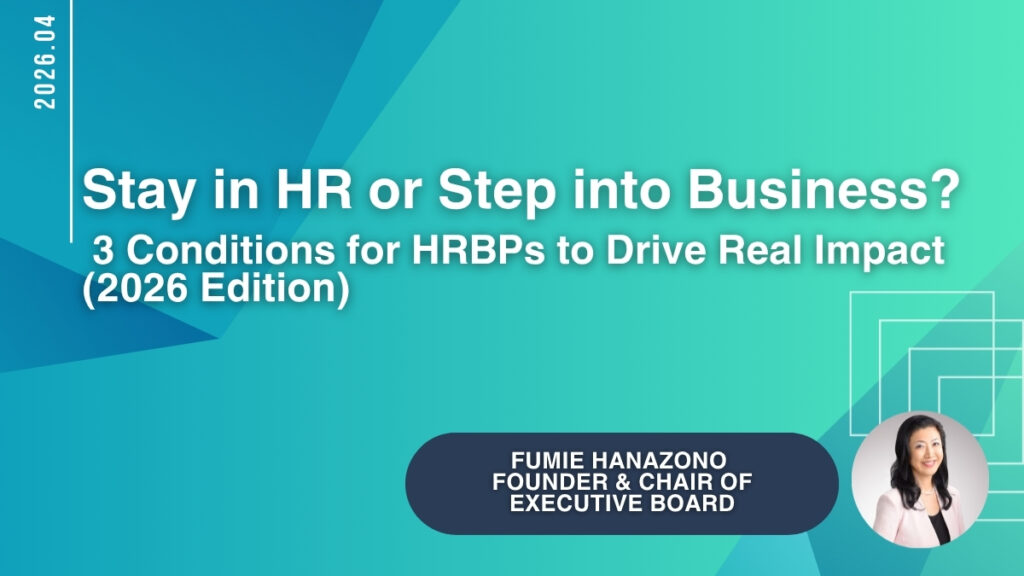
HRBP: Stay in HR or Step into Business? 3 Conditions for Impact
HRBP (Human Resource Business Partner) is a strategic role that drives business impact through human capital. What is an HRBP? It is no longer just an HR function but a core business partner in modern organizations.
What Is an HRBP Today
An HRBP (Human Resource Business Partner) is no longer just an HR function, but a strategic role that directly drives business impact through human capital.
In contrast, traditional HR focused on operations such as recruitment and employee relations.
Today, however, HRBPs work closely with leadership to influence organizational strategy and talent investment decisions.
Furthermore, with the rise of people analytics, AI, and human capital management, the expectations for HRBPs continue to evolve.
As a result, HRBPs are now expected to contribute directly to business performance and decision-making.
Many HR professionals are busy with daily operations.
For example, recruitment, performance management, learning & development, and HR systems each play a critical role in organizations.
However, focusing only on these operational tasks makes it difficult for HR to influence business outcomes.
Therefore, the role of HRBP is becoming increasingly important in bridging HR and business strategy.
But have you ever paused and asked yourself:
“How much impact am I actually making on the business?”
Very few HR professionals can confidently say they are influencing business outcomes.
This is because most HR functions remain positioned as support roles, rather than being directly involved in management decision-making.
And here lies a fundamental crossroads:
Will you remain in HR, or step into management?
This is not about title or position.
The real difference lies in one thing:
How much are you involved in decision-making?
Why HR Struggles to Create Business Impact
In many organizations, HR is still primarily focused on operations:
- Executing hiring plans
- Managing performance systems
- Delivering training programs
These are important—but they are all execution-focused roles.
In contrast, management is about decision-making:
- Which markets to invest in
- Which businesses to expand or exit
- What talent strategy creates competitive advantage
If HR is not part of these decisions,
its impact on the business remains indirect and limited.
HRBP Is Not a Position
A common misconception is around the term HRBP (Human Resources Business Partner).
Many believe it is a job title.
It is not.
HRBP is:
- A function
- A capability
- A role
Even if your organization does not have an HRBP title,
you can still operate as one.
And conversely,
having the title without influencing decisions means you are not truly an HRBP.
3 Requirements to Create Business Impact as HR
1. Business Acumen
To influence management, HR must understand the business:
- How revenue is generated
- Which business units drive profit
- Where competitive advantage lies
Without this, HR proposals remain “nice ideas” rather than strategic inputs.
2. Data-Driven HR (People Analytics)
Modern management is driven by data—and HR is no exception.
- Correlation between turnover and performance
- Effectiveness of recruitment channels
- ROI of talent investments
When HR speaks in data,
it shifts from being seen as a cost center to a strategic investment.
3. Strategic Influence
The most critical element is influence in decision-making.
It is not enough to propose ideas—
they must shape actual business decisions.
This requires:
- Speaking the language of management
- Connecting HR with financial outcomes
- Presenting risks and returns
Global HRBP Trends Shaping the Future of Business (2026 Edition)
In today’s rapidly evolving business environment, the role of the HRBP (Human Resource Business Partner) is undergoing a significant and strategic transformation.
HRBPs are no longer simply supporting business functions; rather, they are increasingly becoming integral to core business decision-making and value creation.
1. From Strategic Partner to Business Driver
Traditionally, HRBPs were positioned as strategic partners supporting business leaders.
However, leading global organizations are now expecting HRBPs to go beyond support and actively drive business outcomes.
In particular, HRBPs are deeply involved in critical areas such as organizational design, talent investment, and market expansion strategies.
As a result, the HRBP role is shifting from advisory to directinfluenceover business performance and enterprise value.
2. Data-Driven HRBP Through People Analytics
Furthermore, the rise of People Analytics has fundamentally reshaped how HRBPs operate.
Today’s HRBPs are expected to make decisions based on robust, data-driven insights rather than intuition alone.
For example, they are increasingly responsible for:
Predicting employee turnover and retention risks
Identifying high-performance talent segments
Optimizing workforce investment strategies
Consequently, HRBP is evolving into a hybrid role that combines HR expertise with advanced analytical and business intelligence capabilities.
3. Integration of AI in HR Decision-Making
At the same time, artificial intelligence is rapidly transforming the HR landscape.
AI is no longer just an efficiency tool; it is becoming a critical decision-support system for HRBPs.
Notably, AI enables:
Talent identification and succession planning
Workforce planning optimization
Real-time employee engagement analysis
However, this shift also requires HRBPs to manage ethical considerations, data governance, and bias mitigation.
Therefore, HRBPs must now bridge the gap between technology, human judgment, and business strategy.
4. Shift from Operations to Pure Strategic Function
Moreover, global HR models are increasingly separating operational HR tasks from strategic roles.
Administrative and transactional activities are being centralized or automated, allowing HRBPs to focus exclusively on high-value strategic initiatives.
As a result, HRBPs are becoming fewer in number but significantly higher in impact, often supporting larger organizational units.
This clearly indicates a shift toward a more elite, high-impact HR function.
5. Skills-Based Organizations and Workforce Strategy
In addition, many global companies are moving toward skills-based organizational models.
Rather than focusing on job titles, organizations are prioritizing capabilities, skills, and future potential.
Accordingly, HRBPs are now responsible for:
Designing skill-based workforce strategies
Leading reskilling and upskilling initiatives
Aligning talent capabilities with future business needs
This shift represents a fundamental transformation from traditional HR practices to strategic human capital portfolio management.
6. The Rising Importance of Human-Centric Influence
Despite technological advancements, the human element remains critically important.
In fact, as AI adoption increases, the ability to influence people and build trust becomes even more valuable.
HRBPs are expected to:
Influence executive decision-making
Shape organizational culture
Facilitate alignment between leadership and employees
Ultimately, the true value of HRBP lies not only in data or strategy, but in the ability to drive meaningful organizational change through people.
Conclusion: HRBP as a Core Business Function
In summary, global HRBP trends clearly indicate a major shift in the role of HR.
HRBP is no longer a support function but a core driver of business performance and enterprise value.
As organizations continue to navigate uncertainty and transformation,
HRBPs who can integrate strategy, data, and human insight will become indispensable to business success.
The Challenge in Japan
In many Japanese organizations:
- HR is positioned as an administrative function
- Distance exists between HR and leadership
- Data utilization is still limited
As a result, HR remains:
“Important—but not influential.”
Global Transformation of HR
Globally, HR is evolving rapidly:
- CHROs are part of executive leadership
- Human Capital Disclosure is advancing
- People Analytics is becoming more sophisticated
HR is no longer a support function—
it is becoming a strategic driver of enterprise value.
Human Capital Management and HRBP
In Japan, “Human Capital Management” is gaining attention.
However, disclosure and metrics alone are not enough.
The real question is:
How human capital is embedded into decision-making
This is where HRBP capabilities are essential:
- Linking people data to business decisions
- Integrating talent strategy with business strategy
- Aligning organizational design with competitive strategy
HR Certification and the Future of HRBP
To perform this role, both knowledge and execution capability are required.
Globally, HR certifications are becoming increasingly important, especially in areas such as:
- Strategic HR
- Human Capital Management
- People Analytics
- Global HR
The Global HR Certification (GHR-Professional™) offered by HRAI is designed to develop HR professionals who can create real business impact from both Japanese and global perspectives.
HRBP is not a title—it is a capability you execute
Your Choice
Now, ask yourself again:
Will you remain in HR, or step into management?
This is not a decision made by your organization.
It is a decision about who you choose to become.
The Next Step
If you want to:
- Influence business outcomes
- Advise management
- Use human capital strategically
- Build a global HR career
Then knowledge alone is not enough.
You need the ability to participate in decision-making
Take Your First Step as an HRBP
If you want to move beyond HR operations and into management:
Start by understanding where you are today.
HRAI offers a practical HRBP program:

This program focuses on:
- Executive-level HR recommendations
- Human capital data utilization
- Integration of HR and business strategy
You can also combine it with:
GHR-Professional™


Career Development Pathways
GHR-Academy offers structured learning paths and globally relevant certifications to support and accelerate your career development.
Route 1
Start with GHR-P (Global HR Education Program):
→ Then move to HRBP Program (after ~3 months):
→ Advance to GHR-ProAdvance™:
Route 2
Already GHR-Professional™ certified?
→ Take HRBP Program
→ Then move to GHR-ProAdvance™ (after ~4 months)


Route 3 (Analysis oriented)
→ Take People Analytics Program

→ Then move to GHR-ProAdvance™ (after 2~3 months)

HRBP Participant Voices
April 2026 Special Opportunity
-1024x576.jpg)
For a limited time in April:
- Enroll in one program
- Get 50% OFF your next program (valid for 6 months)
This is not just a discount.
It is a designed career pathway to your next stage.
Stay in HR, or Step into Management? HRBP Real Dialogue Salon (Limited to 15)|GHR-CONNECTION

On May 11, HRAI will host a private Curated Salon in Tokyo, designed for a small group seeking meaningful, real-world HR dialogue.
Centered on the theme “Stay in HR, or Step into Management?”, the session explores how HR can influence management decisions.
This exclusive gathering offers a rare opportunity to engage in candid discussions with global HR professionals in an intimate setting.
Stay Connected Globally
All GHR-Academy learners receive:
GHR-CONNECTION Membership (1st year free)
Stay connected with global HR professionals and continue learning beyond certification.
Final Message
Will you stay in HR—or step into management?
The answer is defined by your actions.
And if you are ready to take that step—
Now is the time.
Related Articles
People First – Developing Strategic HR Leaders (HRBP: Human Resource Business Partner) Japan’s First! GHR-HRBP™ (Global Human Resource Business Partner) Certification Program
日本語-300x169.png)
HR Connecting Japan to the World: Insights from 25GHR Tokyo

The Global Landscape of Human Resources Certifications: 2026 Edition, Part 1 -What are the HR Certifications recognized as “HR professionals” globally?
-前編-300x169.jpg)
The Global Landscape of Human Resources Certifications: 2026 Edition, Part 2 Global human resources certifications have evolved from merely validating knowledge to certifying the capacity for management participation.
-後編-300x169.jpg)

華園ふみ江
一般社団法人 人事資格認定機構
代表理事
米国公認会計士
ASTAR LLP 代表
-
 HRのままで終わるか、経営に入るか|HRBPがビジネスにインパクトを与える3つの条件【2026年最新版】
-
企業が AI バイアスに向き合うべき理由:リスク回避のためのバイアス監査の重要性 (2026年版)

RELATED ARTICLE
-
HRのままで終わるか、経営に入るか|HRBPがビジネスにインパクトを与える3つの条件【2026年最新版】
-
When Employees Are in Crisis: How Should HR and Employers Respond? – 8 Practical Steps for HR and Employers in the U.S.
-
What is Total Rewards? Compensation Strategies and Global Human Resources Supporting Human Capital Management|Hitachi’s latest case study explained
-
The Expansion of Global HR Functions and Human Capital Management Among Leading Japanese Corporations — Global Trends and the Next Responsibility of Japanese HR —
-
The Global Landscape of Human Resources Certifications: 2026 Edition, Part 1 -What are the HR Certifications recognized as “HR professionals” globally?
-
10 recommended HR qualifications [2026 edition] Qualification acquisition guidance useful for human resources, labor, HR careers, and job changes
-
The Global Landscape of Human Resources Certifications: 2026 Edition, Part 2 Global human resources certifications have evolved from merely validating knowledge to certifying the capacity for management participation.

![10 recommended HR qualifications [2026 edition] Qualification acquisition guidance useful for human resources, labor, HR careers, and job changes](https://hr-ai.org/wp-content/uploads/2026/03/人事資格おすすめ10選【2026年版】-(英語)-300x169.jpg)