The Global Landscape of Human Resources Certifications: 2026 Edition, Part 1 -What are the HR Certifications recognized as “HR professionals” globally?
-前編-1024x576.jpg)
In my column published in May 2021, “The Importance of HR Certifications: The World HR Certifications https://hr-ai.org/new-column/210519/” introduced the key HR Certifications recognized in the United States, the United Kingdom, India, the Middle East, and other regions around the world, and considered the value of HR Certifications as specialized knowledge.
Previously, “certifications help careers” was a common belief, but shifts in the global business landscape and human capital management have altered this perspective. This column uses recent HR certification and compensation data to reassess the changing image and future roles of HR professionals.
The world’s human resources certifications are:
- Certifications that can be used as a universal language
- Certifications institutionalized at the regional and national level
- Specialized Certifications (remuneration, L&D, etc.)
In recent years, new certification categories based on the premise of “human capital management,” “People analytics,” and “management participation HR (CHRO/HRBP)” have been added to this.
List of major HR Certifications in the world (as of 2026)
| Regions | Issuing Organization | Certifications and Certifications | Main target levels | Features and positioning |
| 🌍 U.S.-centered and global | SHRM (US) | SHRM-CP / SHRM-SCP | Practice – Strategy | One of the world’s most recognized HR Certifications: Theory and unique case studies |
| 🌍 U.S.-centered and global | HRCI (US) | PHR / SPHR / GPHR | Practical to Global | Emphasis on exams and clear knowledge system |
| 🇬🇧 Mainly in the UK and Europe + Asia | CIPD | Level 3 / 5 / 7 + Chartered | Beginner to Advanced | Two-tier structure of Certifications + membership system |
| 🇨🇦 Canada | CPHR Canada | CPHR | Professional | Positioning close to national standards |
| 🇦🇺 Australia | AHRI | APC(Practicing Certification) | Practice – Strategy | Emphasis on evaluation of practical ability and behavior |
| 🇸🇬 Singapore | IHRP | IHRP-CA / CP / SP | Beginner to Advanced | State-led HR Certification system |
| 🇭🇰 Hong Kong S.A.R | HKIHRM | Professional Membership | Practical | Membership Level Type |
| 🇿🇦 南アフリカ | SABPP | CHRP, etc. | Practice – Strategy | HR Job Registration System |
| 🌍 Areas of Expertise | WorldatWork | CCP® / GRP® | Compensation Specialty | Specialized in rewards and rewards |
| 🌍 Areas of Expertise | ATD | CPTD® | L&D Expertise | Specialization in human resource development |
| 🌏 From Japan to Global | GHR Academy (HRAI) | GHR-Basic™ GHR-Professional™ GHR-ProAdvance™ | Practical → Strategy → Management Participation | A global standard that integrates global human capital management, People Analytics, and management perspectives. Global Standard Design |
*This information has been compiled by the Institute as a reference material. Please contact each organization for actual Certifications.
Positioning of GHR Academy
GHR Academy is a Japan- global human resources Certification system designed on the premise of “human capital management, × data (People Analytics), × management participation,” while conventional HR Certifications were mainly focused on “HR systems, labor management, and operations.”
In particular, it is clearly different from existing overseas certifications in the following aspects.
- Theory based on the world-standard “global human resources” system
- Design that can explain human capital management and its contribution to “enterprise value“
- Curriculum structure based on the premise of human resources as the right-hand man of management
- A bilingual knowledge system that balances human resources systems and backgrounds in Japan and the world
- Certification acquisition = not a goal, but the purpose is to develop human resources involved in management
Therefore, the GHR Academy presents itself as a “global HR qualification for the next generation” that enhances the global HR Certification system, rather than simply serving as a “replacement for overseas certifications.”
Latest annual salary information for HR positions in the United States
― Market value of “human resources profession” from the perspective of official statistics ―
1. About reference data
The annual salary data used in this section is based on the data provided by the U.S. Bureau of Labor Statistics (U.S. Bureau of Labor Statistics (BLS) is based on the Occupational Outlook Handbook.
The BLS is the official statistical agency of the U.S. government, and wage data uses the “Median annual wage” as of May 2024. The median is the level at which “half of the people engaged in the occupation are more than that, half are less than that”, and it is considered an indicator that is easier to reflect the actual situation than the average value.
2. Median annual salary for key HR positions in the United States, 2024
According to data from the U.S. Bureau of Labor Statistics (BLS), the median annual salary for key HR positions in the U.S. is as follows:
- Median salary of Human Resources Specialists
: $72,910 per year
- Human Resources Managers Median
annual salary: $140,030
- Compensation and Benefits Managers Median
annual salary: $140,360
- Training and Development Managers Median
annual salary: $127,090
All of these are based on the latest official data released by the U.S. Bureau of Labor Statistics in 2024.
3. Graph “Median annual salary of key HR positions in the United States (2024)”
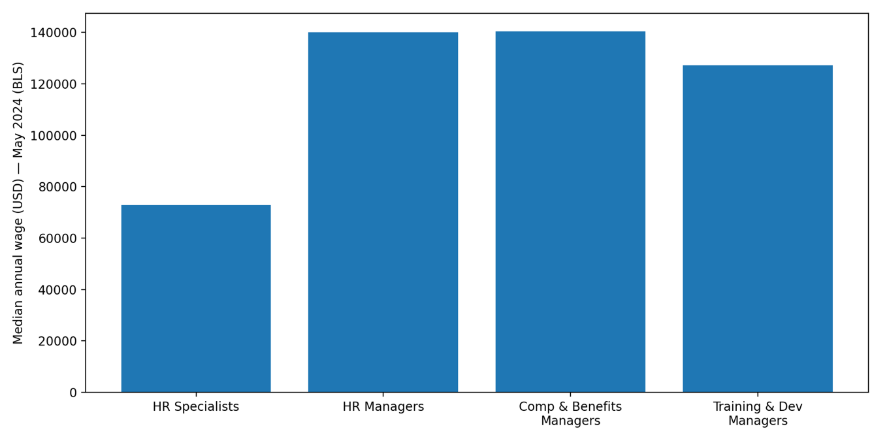
Figure: Median annual salary for key HR positions in the U.S. (2024)
Source: U.S. Bureau of Labor Statistics, Occupational Outlook Handbook(May 2024)
4. What this data means
The most important thing to read from this data is the fact that in the United States, human resources are clearly valued as “professional and managerial positions.”
In particular, the median annual salary of HR and compensation and benefits managers is around $140,000, indicating that HR is positioned as a specialized field that is directly related to management decisions, not just administrative tasks.
On the other hand, there is a large salary gap between HR specialists and managers, and in the United States, “building a career in human resources = reaching the management and strategy level” is clearly reflected in terms of compensation.
2021 Update: Median Salary (Median) Comparison →of U.S. Human Resources (Reference Comparison)
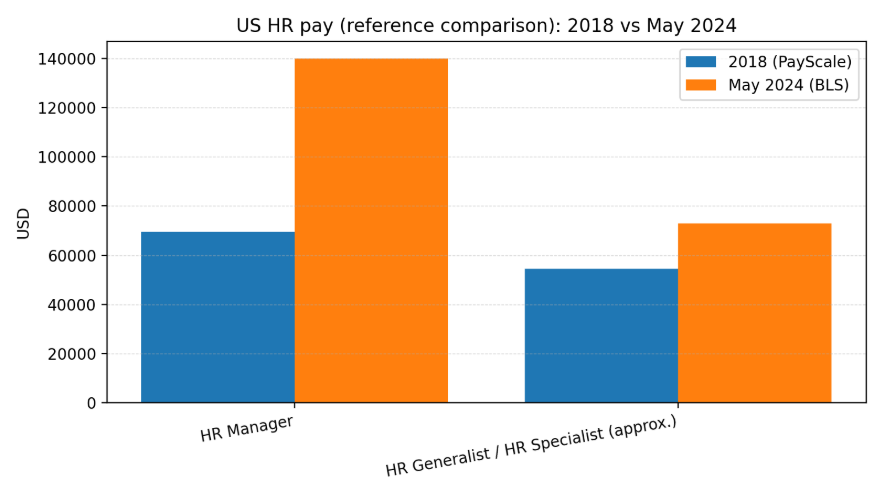
(1) HR Manager
- Value quoted in the 2021 column (PayScale: 2018 data/median qualified person/TCC): $69,500
- The latest value (BLS: Human Resources Managers/May 2024, median annual income): $140,030
- Comparison (increase): +$70,530 (approx. +101%)
Source: 2021 The column cites PayScale’s aggregation (Median TCC, 2018). The latest figure is the median annual income from the U.S. Bureau of Labor Statistics (BLS) Occupational Outlook Handbook in May 2024.
(2) HR Generalist/Specialist (HR Generalist/Specialist) *Approximate comparison
- 2021 Column (PayScale: 2018 / Median Qualified Persons, TCC): $54,500
- The latest value (US BLS: Human Resources Specialists/May 2024, median annual salary): $72,910
- Comparison (increase): +$18,410 (approx. +34%)
Note: The BLS does not provide statistics for a single occupation called “HR Generalist”, but refers to “Human Resources Specialists” as a close occupation group. Therefore, it is an “approximate comparison”.
Why does the annual income of CHROs in the United States exceed USD1million?
― Why you should look at it in terms of “total rewards” rather than annual salary ―
1. CHROs are not “senior HR positions”, but “executives“
When talking about CHRO (Chief Human Resources Officer) in the United States, it is important to note that CHROs are often treated as executive-C suites in listed companies, rather than an extension of the general “human resource management position”.
Therefore, CHRO compensation is not only based on “base salary” but also on total rewards, including stock compensation and bonuses. This is a point that is very different from the understanding that “annual salary = annual income” that is often assumed in Japan.
2. The total compensation of CHROs is “millions of dollars”
A report by Equilar, which analyzes executive compensation at publicly traded companies, shows that total compensation for CHROs is clearly in the “multi-million dollar range.”
For example, Equilar’s analysis shows that the median total compensation for the top 50 CHROs in 2024 is $4.2 million ($4.2M) (which also shows that equity compensation is the largest component).
Another Equilar report also organizes the median total compensation for CHROs on the Equilar 500 in 2024 at $2.4 million ($2.4M).
In other words, in the United States, it is natural for CHRO compensation to be discussed at the level of “total compensation of executives”, which is different from general HR statistics (e.g., BLS Human Resources Managers, etc.).
3. Why it can be said that “there are a lot of more than 100 million dollars” (but as “total compensation”)
CHROs in the United States are often evaluated by “total rewards” that include stock compensation rather than annual salary, and there is an analysis that the total compensation of large, listed companies can be in the millions of dollars. As a result, in yen conversion, “over 100 million” is not uncommon.
(Source: CHRO Compensation Analysis by Equilar: Median CHRO Total Compensation of $4.2M for the Top 50 CHROs in 2024, Median CHRO Total Compensation for Equilar 500 at $2.4M)
4. Why is stock compensation so large?
The reason for the increase in the ratio of stock-based compensation to total CHRO compensation is that in U.S. listed companies, executive compensation design is designed to be linked to medium- to long-term enterprise value (stock price) rather than short-term annual salary.
As a result, CHROs are evaluated as “HR managers” and as core management HR who contribute to enterprise value through human capital strategies, and their compensation is likely to be at the level of executives.
What is the direction of global HR certifications?
― “Evolution of human resources” seen from US annual income data and CHRO compensation ―
What changes when you get a human resources qualification? It is not just an increase in knowledge or an increase in titles. In the world, human resources Certifications are now evolving into an indicator of whether or not a person can talk about management.
In particular, in the world, human resources are clearly positioned as professional and managerial positions, and in the United States, CHROs (Chief Human Resources Officers) are evaluated as members of the executive team, and as total rewards including stock compensation rather than annual salary, they are “over 100 million” in yen terms I told you that it has reached a level that is not uncommon.
We will summarize how the meaning of HR Certifications has changed now in the second part.

華園ふみ江
一般社団法人 人事資格認定機構
代表理事
米国公認会計士
ASTAR LLP 代表
-前編-300x169.jpg)
-
 The Expansion of Global HR Functions and Human Capital Management Among Leading Japanese Corporations — Global Trends and the Next Responsibility of Japanese HR —
-
世界の 人事資格 の現状(2026年版・最新版) 前編 | グローバルで「人事プロフェッショナル」と認識される 人事資格 とは
-前編-300x169.jpg)
RELATED ARTICLE
-
From HR Certification to Global Practice ~ 26GHR-Tokyo Highlights of the Fourth Global HR Conference in Tokyo
-
What is Total Rewards? Compensation Strategies and Global Human Resources Supporting Human Capital Management|Hitachi’s latest case study explained
-
The Expansion of Global HR Functions and Human Capital Management Among Leading Japanese Corporations — Global Trends and the Next Responsibility of Japanese HR —
-
10 recommended HR qualifications [2026 edition] Qualification acquisition guidance useful for human resources, labor, HR careers, and job changes
-
The Global Landscape of Human Resources Certifications: 2026 Edition, Part 2 Global human resources certifications have evolved from merely validating knowledge to certifying the capacity for management participation.
-
HRBP: Stay in HR or Step into Business? 3 Conditions for Impact

![10 recommended HR qualifications [2026 edition] Qualification acquisition guidance useful for human resources, labor, HR careers, and job changes](https://hr-ai.org/wp-content/uploads/2026/03/人事資格おすすめ10選【2026年版】-(英語)-300x169.jpg)
-後編-300x169.jpg)