From HR Certification to Global Practice ~ 26GHR-Tokyo Highlights of the Fourth Global HR Conference in Tokyo
Many professionals pursue an HR certification with clear ambitions: to deepen their expertise, expand their career opportunities and understand global HR practice against international standards.
To translate that learning into workplace impact and career development, we need to continue building a coherent body of knowledge while examining our own organizations from different perspectives. What does management expect of its people? What does human capital management mean in practice? How do HR professionals outside Japan address the same challenges? Viewed through an international lens, where are the strengths and weaknesses of the HR practices we take for granted? What choices lie ahead for the profession? Exploring these questions strengthens our judgment as HR professionals.
The Fourth Global HR Conference, 26GHR-Tokyo, will take place in Tokyo from November 11 to 13, 2026. It is organized by the Human Resource Accreditation Institute, which provides global HR education and professional credentials grounded in international standards.
Across three days, we will bring together perspectives from business leadership, HR, AI and technology, and public policy to consider the future of people and organizations. As the organizer, I would like to share the highlights I particularly encourage you to explore.
Redesigning Work Through Human Intelligence and Artificial Intelligence
A central question for this year’s conference is how Human Intelligence (HI) and Artificial Intelligence (AI), working together, can help us redesign work.
Human intelligence includes the ability to interpret a situation through experience, understand another person’s concerns and engage with people whose values differ from our own. Deciding what matters and what kind of future we wish to create also remains a profoundly human responsibility. How should we bring these capabilities together with AI’s analytical and generative capabilities in everyday work?
The redesign of work involves rethinking its purpose, its processes and the respective responsibilities of people and AI. Which tasks should AI support, and where should people exercise judgment? What new capabilities will employees need? Are our approaches to performance and development keeping pace with changes in the work itself? These questions require HR, business leaders and colleagues across the organization to think together.
Consider an early-career employee whose preparation of reports is now supported by AI. Through what experiences will that person learn to think critically? What needs to change if the time saved is to deepen customer understanding or enable new kinds of contribution? What support will managers need to make that possible?
At 26GHR-Tokyo, we will connect the relationship between HI and AI with talent development and business decisions, exploring what the future of work could look like in practice. Bringing a question your organization has yet to resolve can make that learning especially valuable.
Connecting Leadership Vision with Workplace Reality
One of the conference’s highlights will be the participation of Taro Hiyama, President, Lenovo Japan LLC, and President, NEC Personal Computers, Ltd.
Following his signature speech at the official opening on November 11, Mr. Hiyama will also join us for a workshop on November 12, from 1:30 to 2:30 p.m. Japan Standard Time. Through an interactive exchange with participants, the session will explore workplace realities in greater depth.
The perspective I hope to explore with you is that of placing people at the center and using technology to expand how we work and what we can achieve. Mr. Hiyama brings many years of experience in the IT industry, spanning business in Japan and globally. Through dialogue with him, I look forward to considering how people-centered leadership and the use of technology translate into everyday decisions and practice.
How does a commitment to people translate into the design of work and access to development? How should leaders sustain dialogue when anticipation and anxiety coexist within an organization? Translating vision into practice inevitably involves choices that resist simple answers.
In this rapidly changing age of AI, participants can hear the perspective of a leading business executive in his signature speech, then reflect on it the following day in relation to their own workplaces. I hope these two opportunities will allow us to develop a deeper understanding.
This opportunity will be relevant to HR leaders, talent development and organizational development professionals, and those who lead teams within business functions. It will also appeal to anyone who wishes to learn from a leading executive about the future of work in the AI era and gain a clearer understanding of developments in Japan and internationally. When colleagues from different parts of the same organization attend together, they can return with a shared basis for discussing what the insights mean for their own workplace.
SoftBank and Lenovo joint announcement • NEC announcement naming Taro Hiyama • NEC Personal Computers corporate profile
A Global HR Conversation Across Asia Africa and the Americas
Global HR Certification holders from Japan and glove also gather together
Confirmed participants already extend well beyond Japan. They include professionals from the Philippines, Cambodia, Brunei, Singapore, Hong Kong and Malaysia, alongside participants from Africa and the Americas.
Similar challenges in recruitment or talent development can arise in very different contexts. Industry structures, education systems, employment practices and people’s expectations of work all influence the response required of HR. An international conference allows us to understand these differences through the experiences of the people addressing them.
Many Japanese companies remain cautious about introducing and using AI in the workplace, while the gap between their progress and implementation overseas continues to widen. Hearing directly about what is happening in other countries offers Japanese organizations a valuable opportunity to learn.
Global HR concerns professionals working within domestic organizations as well as those responsible for overseas operations. Many workplaces bring together colleagues from diverse backgrounds while serving customers and working with partners abroad. Understanding different assumptions and finding common purpose are increasingly relevant professional capabilities.
The international character of a conference comes to life when people with different experiences engage with the same question. That is the kind of dialogue we hope to create together in Tokyo.
Every Program in Japanese and English
All programs throughout 26GHR-Tokyo will be delivered in Japanese and English. We want participants from Japan and overseas to be able to share their knowledge and learn together.
Some Japanese participants may hesitate to attend an international conference because they lack confidence in English. Here, they will be able to follow the content in Japanese while encountering perspectives from abroad. Hearing familiar HR concepts expressed in English can also help place those concepts in an international context.
A conversation does not have to begin with a complex question. “This is something our organization is struggling with. How are you approaching it?” A brief account of your own experience can be enough to establish a connection.
Above all, I hope participants will bring a willingness to understand others and to contribute their own experience. That openness can become the foundation of professional relationships that continue well beyond the conference.
Responsible AI in HR with Fisher Phillips
We are grateful to Fisher Phillips, the international law firm supporting 26GHR-Tokyo as a sponsor. With its focus on labor and employment matters, the firm advises employers on workplace challenges across borders. Its support for the conference, together with the expertise shared through its participation, makes a valued contribution to this exchange among global HR professionals.
The workshop “AI in HR: Where Bias Hides” will feature John Albers, Executive, Fisher Worldwide, and Nan Sato, Co-Chair International Practice Group, Regional Managing Partner – Tokyo, Fisher Phillips. The session is scheduled for November 13, from 2:00 to 2:30 p.m., followed by questions and answers until 2:40 p.m. Japan Standard Time.
Ms. Sato serves as Co-Chair International Practice Group and Regional Managing Partner – Tokyo at Fisher Phillips. A U.S.-qualified attorney, she advises Japanese companies on the challenges of international business, including labor and employment matters, overseas expansion, cross-border remote work, and employment and data privacy issues arising from mergers and acquisitions. She also holds the Certified Information Privacy Professional credentials for Europe and Canada, CIPP/E and CIPP/C. Participants will be able to learn directly from a specialist who connects global HR practice with the legal dimensions of data handling, and to raise their own questions during the Q&A.
John Albers, Executive, Fisher Worldwide, will travel from the United States to speak at this workshop.
The session will examine where bias can arise in résumé screening, gamified assessments and performance analytics. It will also consider responses such as bias testing, human oversight and vendor due diligence, helping HR professionals think through what responsible AI adoption requires.
For HR professionals supporting people who work across countries and regions, an understanding of technology must be informed by legal and ethical considerations. The opportunity to speak directly with an attorney from an international law firm, and to re-examine recruitment and evaluation practices within our own organizations, is one of the workshop’s particular strengths.
When introducing AI into recruitment or performance evaluation, improvements in efficiency deserve attention. So do the information on which a decision rests and whether its outcome can be explained to the person affected. A numerical score or ranking requires scrutiny of how it was produced before it can inform a sound judgment.
If AI supports the assessment of a candidate, can HR explain why that candidate received a low score? Could the system reproduce biases embedded in past hiring decisions? Who will review an unexpected result and decide whether the initial assessment should stand?
These questions belong in the discussion from the point at which a system is being considered. Combining HI and AI requires clarity about where people exercise judgment and take responsibility. I encourage participants to use this opportunity to apply the principles of fairness and ethics explored through HR certification to concrete professional situations.
Nan Sato official profile • Fisher Phillips official website
Reskilling Experienced Employees at the Nippon Paint Group
GHR-ProAdvance™︎ – Advanced HR Certification Holder Presents
Another masterclass to look forward to is led by Yasuyo Goto, Manager, Human Resources Department, Nippon Paint Corporate Solutions Co., Ltd. Its announced title is “Connecting Tradition to the Future Through Talent Development,” with the subtitle “Reskilling Senior Employees at the Nippon Paint Group.”
Ms. Goto holds the GHR-ACADEMY™ credentials GHR-Professional™, GHR-PA™ and GHR-ProAdvance™, currently the academy’s highest-level credential. Her continued investment in qualifications and learning exemplifies the development of a career as a global HR professional. Her masterclass also offers an opportunity to consider how that learning connects with talent development in a corporate setting.
Reskilling calls for attention to what employees already know as well as what they need to learn. Long-standing customer relationships, the ability to solve problems in the workplace and the instinct to notice when something is amiss are all forms of expertise developed through experience. How can these strengths contribute to tomorrow’s business and tomorrow’s work?
Even a well-designed learning program may struggle to motivate someone who cannot see a future role for themselves. Opportunities to use new knowledge, together with support from colleagues and managers, are equally important. HR needs to consider learning and the work that follows it as connected parts of the same undertaking.
A company’s experience can illuminate the reasons behind an initiative and the challenges its HR team had to address. Reflecting on the similarities and differences with our own organizations helps turn a case study into practical insight. For Japanese companies already facing an aging workforce, reskilling experienced employees is an especially relevant way to connect talent development with the redesign of work.
Nippon Paint Holdings group directory • Conference program and speaker materials
How Global HR Can Shape Business Decisions
Leading Global HR Certification from Japan
My own masterclass, “How Global HR Can Shape Business Decisions,” with the subtitle “Lessons from Japan and the World,” will explore how people and organizational strategy can inform business judgment.
A proposal for talent development should explain which business challenge it is intended to address. A request to increase recruitment should identify the capabilities that are missing and consider whether development or internal mobility could meet the need. HR recommendations become more persuasive when they connect employees’ experience with the realities of the business.
The same discipline applies to AI and people analytics. The starting point is a well-framed question. Beyond calculating a turnover rate, we need to understand who is leaving, what they have experienced and under what circumstances they depart. Alongside training satisfaction, we should examine what has changed in the work itself. Interpreting the context behind a number is essential to using it well.
How can HI and AI together improve the quality of decisions? How can the redesign of work expand both human capability and business opportunity? I look forward to exploring these questions with participants through the lens of everyday practice.
Connecting HR Certification with Continuing Professional Development
Studying for an HR certification provides an opportunity to organize professional experience within a broader body of knowledge. Learning beyond the boundaries of our current responsibilities can reveal both our strengths and the areas in which we need to develop further.
The Human Resource Accreditation Institute offers global HR education programs, including GHR-P™, through which professionals can develop a comprehensive understanding of global HR grounded in international standards and earn a professional credential. Beyond qualification, we provide continuing learning opportunities and GHR-CONNECTION™, a platform for exchange among global HR professionals. Through these opportunities, we support their development in Japan and internationally. Explore the GHR-P program.
Applying a principle at work often reveals complexities that were less apparent in the classroom. Business leaders and colleagues may have different priorities; a policy may be carefully designed yet prove difficult to implement. Dialogue with practitioners from other organizations and countries can help clarify what lies behind these difficulties.
For those considering an HR qualification, the conference can help identify what they most want to learn. For credential holders, it offers a setting in which to apply established knowledge to current challenges and discover the next area to explore. I also invite experienced professionals to share what they have learned with participants from around the world.
GHR-CONNECTION official page
Bring Your Questions to Tokyo This November
The official opening and gala dinner on November 11 will take place at the International House of Japan. Masterclasses and workshops on November 12 and 13 will be held in the International Convention Hall at the House of Representatives First Members’ Office Building. These distinguished venues will provide the setting for our international exchange. All programs will be delivered in Japanese and English.
Before attending, consider choosing one question that matters to your workplace. How can we develop early-career colleagues as AI becomes part of their work? How can employees’ experience contribute to new responsibilities? What would make HR’s recommendations more useful to business leaders? A question gives purpose to the sessions we attend and the conversations we begin.
This conference is sustained by participants’ desire to learn and connect. Professionals from Japan and across Asia, Africa and the Americas will bring their experiences to a shared discussion about the future of HR and work. I warmly invite you to be part of it.
Our philosophy is “HR Connecting Japan to the World.” We seek to share Japanese practice internationally and bring global perspectives back into workplaces in Japan. Each of us has a part to play in building that bridge and advancing the HR profession together.
For the latest program, participation details and registration, please visit the official 26GHR-Tokyo website. I look forward to welcoming your questions, experience and perspectives to Tokyo.
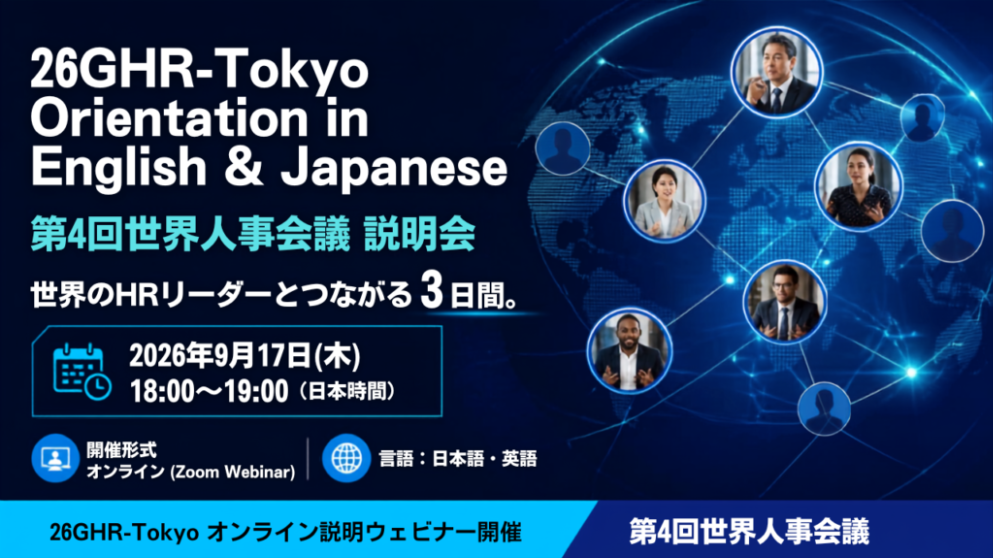
Free Online Information Session for 26GHR-Tokyo
Join our online information session on the Fourth Global HR Conference.
September 17, 2026 | 6:00–7:00 p.m. Japan Standard Time
Zoom | Free of charge
View details and register for the information session.
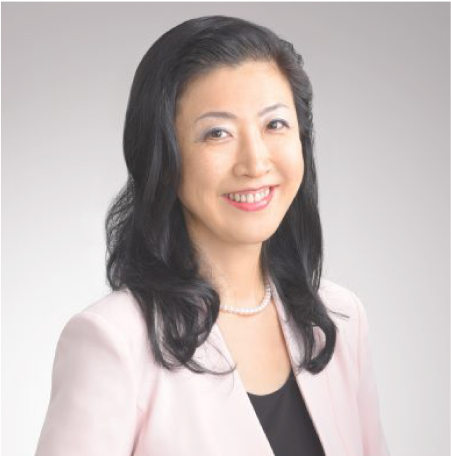
華園ふみ江
一般社団法人 人事資格認定機構
代表理事
米国公認会計士
ASTAR LLP 代表
-
 北朝鮮の詐欺師がITフリーランスを装っている ― グローバル人事 担当者 が知っておくべき本人確認、契約社員リスク、グローバル人材ガバナンス
-
人事 資格 の学びを世界の実践へ〜第四回世界人事会議「26GHR-Tokyo」の見どころ
RELATED ARTICLE
-
米国 の従業員がメンタルヘルス危機に直面したら― 米国 人事・雇用主が押さえる8つの実務対応
-
When Employees Are in Crisis: How Should HR and Employers Respond? – 8 Practical Steps for HR and Employers in the U.S.
-
人事 資格 の学びを世界の実践へ〜第四回世界人事会議「26GHR-Tokyo」の見どころ
-
The Global Landscape of Human Resources Certifications: 2026 Edition, Part 1 -What are the HR Certifications recognized as “HR professionals” globally?
-
10 recommended HR qualifications [2026 edition] Qualification acquisition guidance useful for human resources, labor, HR careers, and job changes
-
The Global Landscape of Human Resources Certifications: 2026 Edition, Part 2 Global human resources certifications have evolved from merely validating knowledge to certifying the capacity for management participation.
-
第一回「世界人事会議」基調講演スピーカー アンガス・マグレガー様 インタビュー Vol.2
-
第一回「世界人事会議」基調講演スピーカー アンガス・マグレガー様 インタビュー Vol.1
-前編-300x169.jpg)
![10 recommended HR qualifications [2026 edition] Qualification acquisition guidance useful for human resources, labor, HR careers, and job changes](https://hr-ai.org/wp-content/uploads/2026/03/人事資格おすすめ10選【2026年版】-(英語)-300x169.jpg)
-後編-300x169.jpg)

